Buyers often use these three names interchangeably, but they are three different mechanisms with different failure points, different footprints and very different costs of change. Choosing wrongly usually shows up at the second event rather than the first — either the graphic cannot be replaced, or the stand does not survive being packed and unpacked.
This guide compares them by mechanism, then maps each to the situation it suits.

Three Mechanisms, Three Jobs
| Format | Mechanism | Graphic change | Footprint | Typical strength |
|---|---|---|---|---|
| Roll-up / retractable | Printed graphic retracts into a cassette base and is pulled up on a telescopic pole | Graphic replaceable on the same base | Narrow base, vertical | Repeated use, transportable |
| X-banner | Graphic stretched across a folding X frame, held at the corners | Graphic replaced separately from the frame | Cross base with a wider spread | Lowest entry cost, very light, fast set-up |
| Pop-up / panel | Panels or a printed skin over a folding frame, generally as a backdrop | Whole panel set changes | Wide; needs a backdrop footprint | Large continuous graphic area |
The mechanism determines three things buyers underestimate: what happens to the graphic when the message changes, how the unit behaves in transit, and how much floor space the base claims.
Roll-Up Banner Stands: When the Graphic Will Change
A roll-up stand is a cassette with a spring-loaded roller inside. The graphic retracts into the base at the end of the show, and a telescopic pole sets the height.
Specify a roll-up stand when:
- The display will be used repeatedly — the cassette protects the graphic in transit.
- The message is likely to change — replacement graphics can be ordered on their own, which costs far less than a new stand.
- The booth has a defined position for one or two vertical displays and floor space is tight.
Sizes. The 80 cm width is the most common specification because it is easy to carry and still reads clearly at normal viewing distance. 60 cm is also available for tighter positions. Confirm the width the stand is built for and order the graphic to match; a graphic printed to the wrong width cannot be reused on that base.
For the detail on this format — printing substrates, panel options and the graphic specification — see our guide to choosing a roll-up banner, and for how the format entered the market, the history of pull-up banners.
X-Banner Stands: the Low-Cost Format
An X-banner stretches its graphic over a folding frame and supports it from a cross base. It is the least expensive of the three, packs flat and goes up in under a minute.
The trade-off is durability and graphic handling. The frame is light because it is thin, and the graphic is held at its corners, so the material has to take tension without tearing at the eyelets. For a single event or a short indoor promotion that is a reasonable trade; for a stand that travels twenty times a year it usually is not. We produce X-banner stands, but we position them as the low-cost entry format rather than the main line — for repeat use the roll-up cassette is the better buy even at a higher unit cost.
Pop-Up Displays: When Graphic Area Is the Point
Where the objective is a back wall or one large continuous graphic, neither a roll-up nor an X-banner is the right answer. Pop-up and panel systems exist to cover area: they trade floor footprint and assembly time for width and a finished appearance.
Specify them when the booth is being built as a room — back wall, side graphics, counter — rather than as a single sign.
Matching the Format to the Booth
| Booth situation | First choice | Why |
|---|---|---|
| 2 × 2 m shell scheme, one message | Roll-up stand | Narrow base, no spread, protects the graphic in transit |
| Open floor, need height and reach | Two roll-up stands | A vertical format is read from further away |
| One-off event, tight budget | X-banner | Lowest entry cost, fastest set-up |
| Corner or aisle position | Roll-up at the aisle edge | Visibility without blocking circulation |
| Backdrop or continuous wall | Pop-up / panel system | Area, not height, is the requirement |
| Travelling roadshow kit | Roll-up plus a small table-top format | Both pack into cases; bases stay small |
Two rules apply across all three formats: keep the visual line at a consistent height across the set, and put the graphic where visitors walk, not where the salesperson stands.
Packing and Carry Options
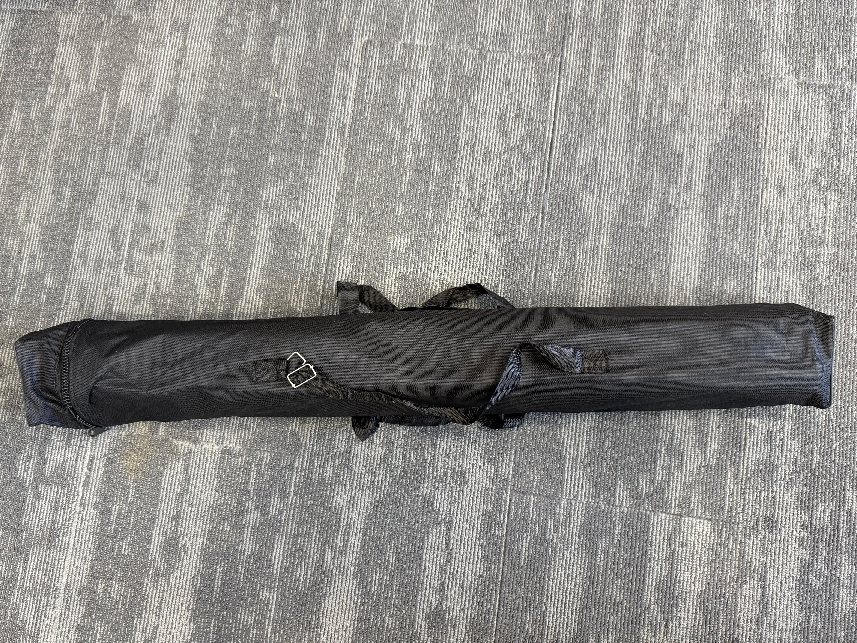
Roll-up stands are supplied with a carry bag as standard, and a heavier-duty bag is available where the kit travels frequently or is handled by third-party logistics. If the stands will be checked in as luggage or shipped between shows, say so at quotation stage — the bag specification should match the journey, not just the stand.
One client put this to the test at scale: a Canadian sauna manufacturer compared suppliers, tested a sample, then ordered 800 sets — read how that programme was de-risked.
Ordering Notes
Tell us the format, the quantity and whether the graphic will be reused. Browse the 60 × 160 cm roll-up banner and the aluminium retractable roll-up display stand.
Sample production takes about 3 days; production runs about 7–15 days depending on quantity. We will confirm the schedule with the quotation.
Get a Quote for Your Display Programme
Send the booth plan, the format you are considering and the artwork. We will confirm the stand, the graphic specification and the schedule, and return minimum quantity and lead time. See the full advertising display range for tents, counters and accessories that usually ship with a stand order.