In display hardware, the lowest quote rarely wins the order. What wins is confidence that unit 400 will look exactly like unit 1 — and that confidence is usually bought with a sample.
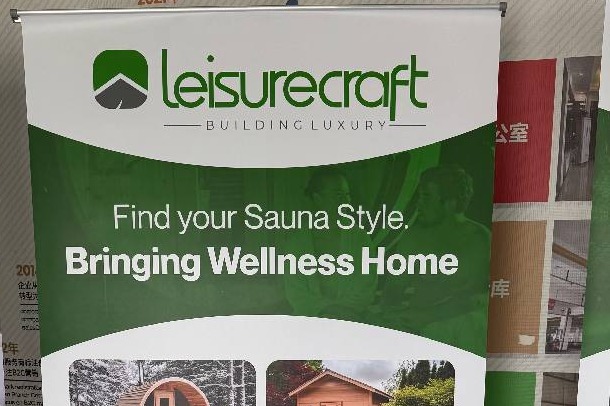
This is how an 800-set roll-up display order came in from a Canadian manufacturer of sauna rooms and cold plunges.
The Brief: One Display, an Entire Product Range
The client’s problem was not “we need a banner”. It was that their range had grown — barrel saunas, outdoor cabins, pods, panoramic models, cold plunges — and each had to be recognisable from a photograph at display scale, in front of buyers comparing them side by side.
That shifts the requirement away from design and towards production consistency. A display programme repeated across many units is only as good as its weakest unit: one dull print or one stand that will not stay upright makes the whole set look careless. For a manufacturer whose own brand is built on Canadian-made quality, that was the real risk.
The Comparison Round
The client was already shopping: they ran multiple rounds of price comparison before deciding anything. Price, however, was not the deciding factor, because an order of this shape is not a one-off purchase — it is a repeatable fixture of a sales process.
So before committing to a production run, they ordered a sample.
What a Sample Has to Prove
A sample is not a preview of the design. Four things have to hold up:
- Print quality on the actual substrate. Colour density and sharpness behave differently on a printed graphic than the same artwork does on a screen — and this client’s graphics were photograph-led.
- The mechanism. Whether the stand sets up cleanly and retracts properly after use decides whether the unit survives the second and third event.
- Hardware finish on the base and pole. These are the parts handled every time the stand goes up and comes down.
- The carry bag. A display damaged in transit never reaches the event, and this is the part buyers most often forget to check.
A sample that passes those four checks de-risks everything that follows. That is precisely why the sample stage exists in this trade.
The Order: 800 Sets
After testing the sample, the client placed an order for 800 sets — a programme rather than a purchase, for promoting their products in front of trade buyers and end customers.
The value of the sample stage shows up here. Once the physical reference had been approved, the 800-set run became a production question rather than a design question: same graphic reference, same hardware, same packing, no surprises to absorb at unit 500.
What This Means If You Are Buying Displays
Three points carry over to any display programme:
- Sample before you scale. The cost of a sample is trivial against the cost of a run that turns out to be wrong.
- Ask about the parts that get handled. Print quality is what buyers judge, but bases, poles and bags are what determine service life.
- Fix one reference and keep it. If a programme will be repeated, agree a single approved sample as the production standard and refer later orders back to it.
Ordering the Same Way
We produce roll-up banner stands and supply retractable display stands, and replacement graphics can be ordered so a programme can be extended or updated without replacing the hardware. Carry bags are supplied as standard, with a heavy-duty option depending on how the kit travels.
If you are sourcing displays for a repeatable programme, send us the range, the artwork and the number of locations, and we will quote the sample first. You can also read our guide to choosing between roll-up, X-banner and pop-up formats or see the full advertising display range.