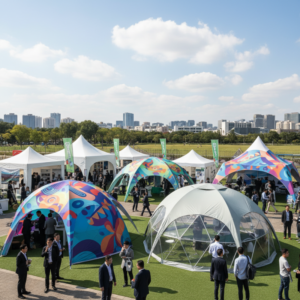
The table is usually the first surface a visitor touches at a show, and it is the cheapest piece of the booth to brand properly. A printed table cover carries your logo at eye level, hides the stock, bags and cables underneath, and makes a 3 m shell scheme look intentional. This guide covers the specification decisions that actually change how a cover performs — construction, sizing, fabric, print method and artwork.
Why a printed cover earns its place
A cover does three jobs at once: it brands the booth front, it turns an open table into storage, and it makes every event you attend look like the same company. Because the same cover is reused for years, the cost is spread over dozens of shows — which is why the fabric and print method matter more than the unit price in the first quotation.
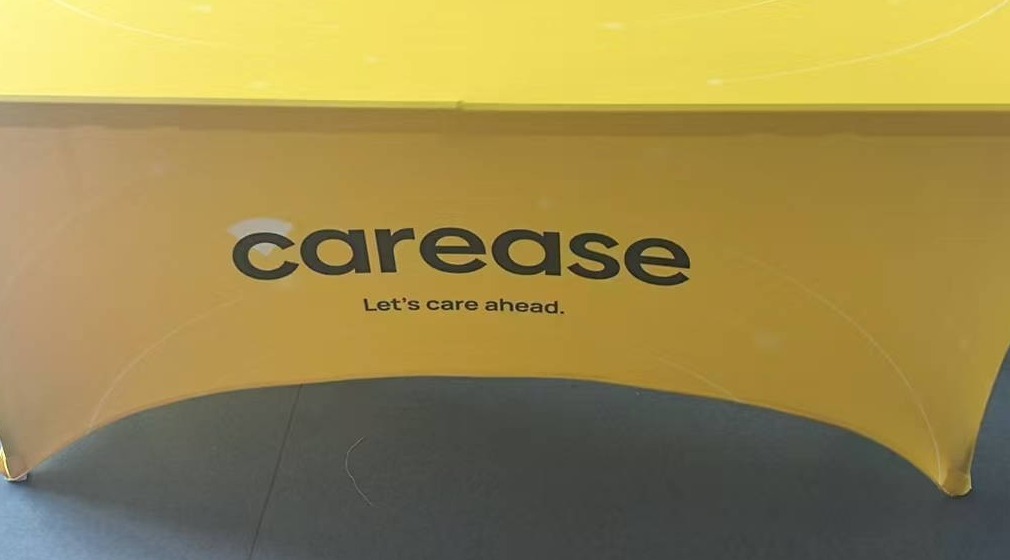
180 gsm stretch cover on a 6 ft trestle table
Pick the construction before the artwork
| Construction | Behaves like | Best when |
|---|---|---|
| Fitted / stretch cover | Tailored 4-side fit, tight to top and legs | You want a clean, premium front and no loose fabric |
| Table throw | Top plus three sides, open back | Staff need to reach stock behind the table quickly |
| Table runner | Printed band on the top surface only | The table itself is presentable, or you change branding often |
| Pleated skirt | Hangs below the table edge | Reception and registration desks in a fixed room |
A throw is the fastest to deploy; a fitted cover photographs best and does not need re-dressing every morning; a runner is the cheapest way to add a logo to tables you do not own.
Measure the table, then decide the drop
Two measurements decide the whole cover: the table top and the drop. Common show tables are 4 ft (48 × 24 in), 6 ft (72 × 30 in) and 8 ft (96 × 30 in), all 29 in high. For a fitted cover the drop determines whether the fabric reaches the floor or stops at knee height; for a throw it decides how much of the sides is printed. Measure an actual table rather than trusting a venue plan, and note whether the venue forbids covers touching the floor.
Fabric and print: what changes durability
- Base cloth. Woven polyester or oxford cloth is the standard reusable option; stretch fabric is chosen for fitted covers that must stay smooth.
- Print method. Dye-sublimation prints unlimited colours into the fabric and is the norm for full-graphic covers; screen print or transfer suits a single logo on a solid colour and is usually the cheaper route at low colour counts.
- Finishing. Reinforced hems, leg pockets, a zippered back and a carry bag change how long a cover survives normal show handling.
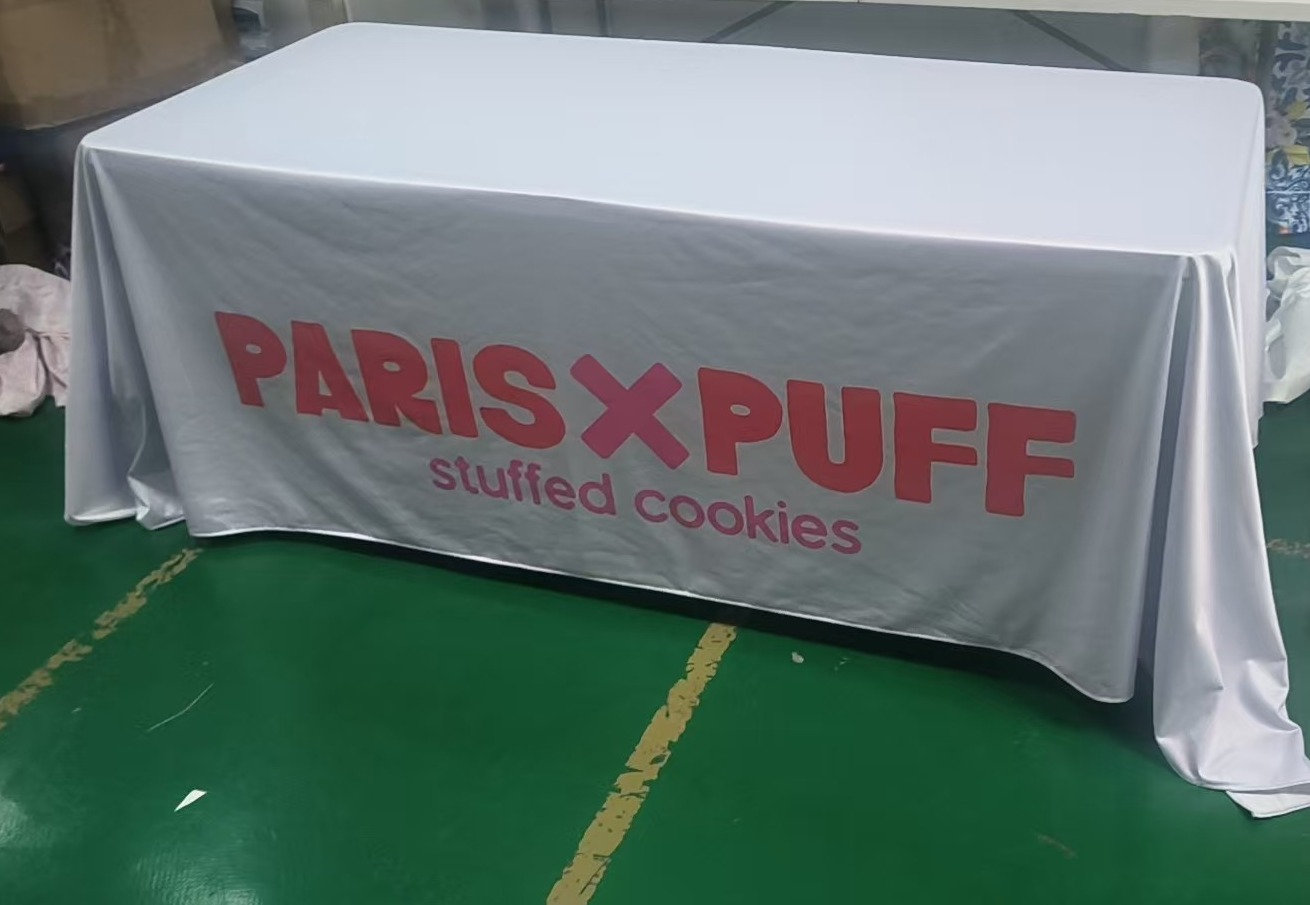
250 gsm polyester cover, printed with the client’s logo
Ask your supplier which cloth and which print method they propose for your design, and why — a quotation that names the fabric and the print method is easier to compare than one that lists a price only.
Specifications
| Item | Specification |
|---|---|
| Base fabric | 180 gsm stretch knit (fitted covers) · 250 gsm polyester (draped covers) |
| Standard sizes | 6 ft (72 × 30 × 29 in) and 8 ft (96 × 30 × 29 in) trestle tables; custom sizes made to your table dimensions |
| Printing | Dye-sublimation, digital print, screen print and embroidery |
| Edge finishing | Fringe / tassel edging available |
| Construction options | Zippered back, leg pockets, weighted hem, reinforced hems, carry bag |
| Care | Machine washable; not stain-resistant |
| Minimum order | 1 piece |
| Production time | 3–5 days after artwork approval |
| Reference packing | 53 × 30 × 37 cm carton holds 10 pcs (250 gsm, 6 ft); carton weight approx. 19 kg |
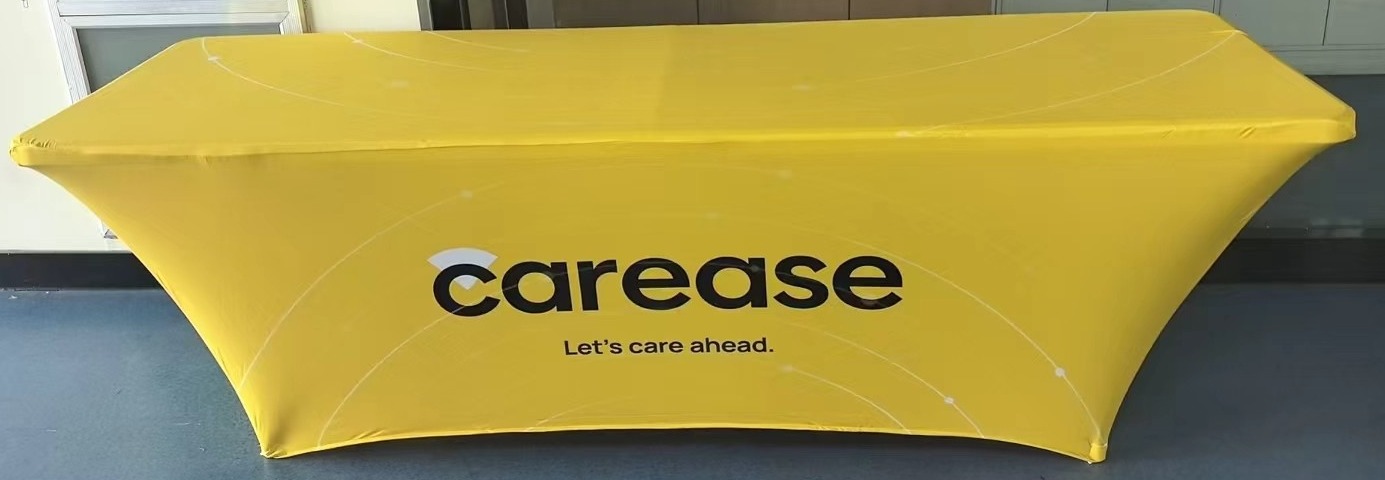
Stretch cover on an 8 ft table
Artwork rules that avoid expensive reprints
- Supply vector artwork (AI, EPS, PDF) or a high-resolution file — logos pulled from a website screenshot will look soft on a 2 m printed area.
- Work to the cover’s dieline, not to a flat rectangle: the top surface, the front panel and the corner wraps are separate print areas on a fitted cover.
- Keep critical text away from seams and corners, where pattern placement shifts.
- Check logo scale at distance: a logo that reads well on a business card is often too small from three metres away.
- For all-over prints, supply a seamless repeating pattern and state the intended repeat size.
What actually drives the price
Cover quotations move with five things: the table size (fabric consumption), the print coverage (a logo versus a full-bleed graphic), the print method, the finishing specification, and the order quantity. Freight is the sixth: covers pack flat and light, so combining them with flag poles, canopies or banner stands in one consolidated shipment usually reduces the landed cost per unit more than negotiating the unit price does.
A recent table cover project
A US brand running a corporate gifting programme started with a sample cover in August 2026; after the sample was approved, the bulk order followed in September 2026 for 500 pieces. The covers shown on this page come from that programme — a 180 gsm stretch cover for a 6 ft and an 8 ft table, and a 250 gsm polyester cover with a printed logo.
Questions worth asking before you order
- Which cloth and weight is being quoted, and is it washable?
- Is the print dye-sublimated or applied on top of the fabric?
- Does the cover come with leg pockets or a weighted hem for outdoor use?
- Will the logo land on the front panel or across a corner seam?
- Can the covers ship together with the rest of the display order?
FAQ
What size cover fits a 6 ft table?
A 6 ft trestle table is normally 72 × 30 in with a 29 in height. Ask for the cover dimensioned to that top size and state whether you want a full floor drop or a shorter drop.
Can photos be printed on a table cover?
Yes — dye-sublimation printing reproduces photographic artwork across the full surface. Supply a high-resolution image and expect the colour to shift slightly against the fabric’s white point.
Are printed covers machine washable?
Yes. Both the 180 gsm stretch cloth and the 250 gsm polyester are machine washable. They are not stain-resistant, so pre-treat marks before washing and keep the cycle cool.
What is the minimum order quantity?
One piece. Single-show samples and bulk runs are quoted the same way, and production runs 3–5 days after the artwork is approved.
How long does production take?
Three to five days after the artwork is approved. The clock starts from the approved mock-up, not from the first draft, so approve the layout early.
Can table covers ship with other display items?
They can. Covers are flat and light, so they consolidate well with poles, canopies and banner stands — one shipment, one set of documents, one delivery to the venue or warehouse.
If you have the table size and the artwork, we can come back with a layout and a quotation: send your details here. You can also see the full custom table cover specification or browse advertising display products and our OEM/ODM service.