Most flagpole enquiries arrive in the wrong order. The buyer asks for a height, or for a material, before either question can be answered — because both are decided by two things that come first: the flag that has to be flown, and the site that has to hold the pole.
The flag decides the pole
A flag is a sail and a pole is the mast. The larger the flag, the more load it puts on the pole, on the fixings and on whatever holds the base down. That is why the decisions run in one direction:
- What has to be seen, and from how far. A flag at the edge of a car park reads completely differently from one over a shopfront, and the size that gets noticed is set by the distance rather than by preference.
- The flag size that follows from that.
- The pole height that carries the flag. A flag too large for its pole will wrap, whip and wear at the heading; too small and it disappears against the sky.
- The fixing that holds the pole, which now has to resist the load the two previous decisions created.
Tell us the first item and we will work through the rest. Tell us only a height, and the result is usually either an oversized pole or an undersized flag.
Flag size is not fixed to the pole
There is no rigid size-to-pole table here. Any flag size can be paired with any pole height to order; the pairing most buyers settle on is simply the one that is most common in the market, and 3 × 5 ft is the most frequently specified size. Larger flags on the same pole are entirely workable — and the taller the pole, the more the flag is on display, which is usually the point. If you have a flag already, tell us its size and we will match the pole to it; if you have the pole, we will advise on the flag.
The heights we build
| Height | Where it is normally specified |
|---|---|
| 8 ft | Light-duty and domestic sites: a garden, a low shopfront, a small forecourt |
| 12 ft | Small commercial premises and forecourts where the flag has to be seen from a road |
| 15 ft | Mid-size commercial frontage; the usual step up when a 12 ft pole looks crowded |
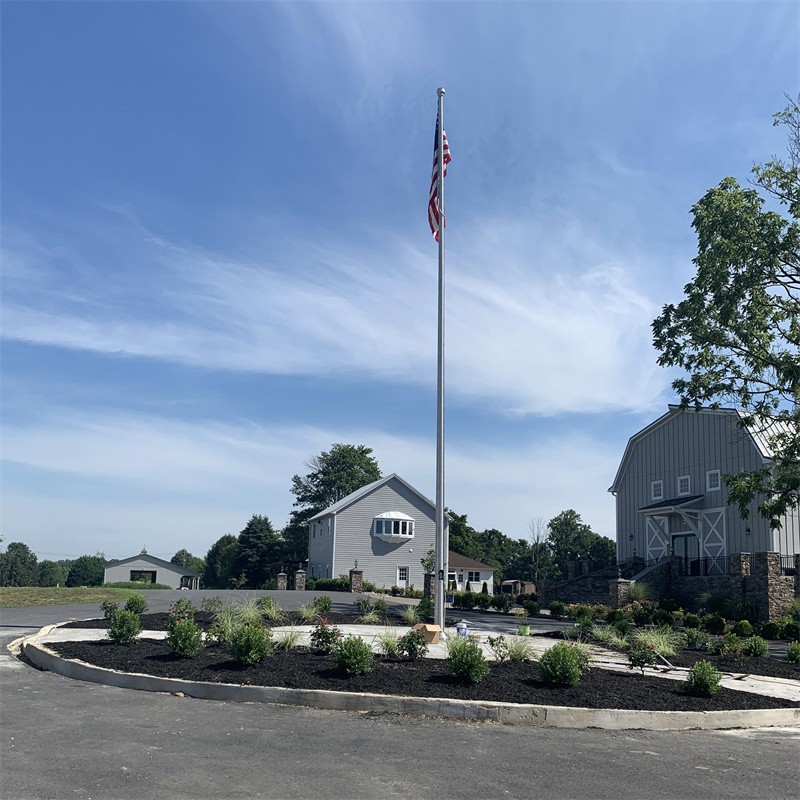
| 20 ft | Commercial buildings, car dealerships, business parks — the most common commercial height |
| 25 ft | Larger frontages and sites where the flag has to be legible from a distance |
| 30 ft | Large commercial and municipal installations, flagships and roadside positions |
We also build a metric range — 3 m, 6 m and others — because not every market specifies in feet. Beyond these, height is a custom dimension rather than a fixed catalogue entry.
Material: what each one is actually chosen for
There is no universally best pole material. Each is the right answer to a different question.
Fibreglass. Non-conductive, so it is the safe choice where the pole will stand near overhead lines. It does not dent and does not take a permanent bend, and the colour runs through the section rather than sitting on the surface — which is why it holds up in coastal air. We build it from 3 m up to 30 ft.
Aluminium. The best strength-to-weight option, which is why the telescoping and rotating designs are aluminium: a telescoping pole has to be light enough for one person to raise, and a rotating pole has to turn freely in light air. Our aluminium poles are built with a 1.0 mm wall thickness, which is the specification that decides how rigid the pole feels and how much it flexes when the flag loads it.
Stainless steel (304L and 316L). Chosen for corrosion resistance and for a finish that survives being looked at closely. 316L is the grade specified where the environment is more aggressive — marine air, industrial atmospheres — because it resists chloride attack better than 304L.
Brass. Appearance-led: specified where the pole is part of the interior or the architecture rather than a piece of street furniture.
Wood. Traditional and ceremonial — the pole is there to look established rather than to be the cheapest way to hold a flag up.
Plastic. Light-duty and low-cost, for small flags and short-term use.
The mounting decides the installation
Two poles of the same height can require completely different installations, and this is the decision buyers most often leave to the end:
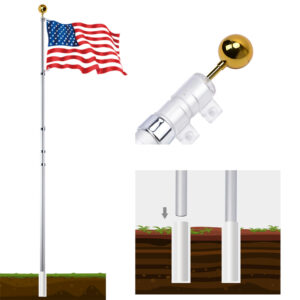
- In-ground. The pole is set into a foundation, so the ground has to be opened, prepared and finished. The foundation depth follows the pole height rather than being a fixed figure, and in practice runs to 30–60 cm. Our in-ground poles are supplied with the flange and the anchor bolts included, so the pole is ready to be set rather than needing hardware sourced locally.
- Wall-mounted bracket. No ground works, but the wall has to carry the load — and the bracket angle decides how the flag presents.
- Surface-mounted base. The pole stands on a base rather than in the ground, which suits hard standing, roofs and temporary positions.
- Suction cup, magnetic and vehicle fixings. For flags that travel: cars, vans and promotional vehicles. Deliberately not permanent.
- Marine, bike and backpack fixings. Small-gauge poles for flags that move with the user or the vessel.
In-ground installation and surface-mounted bases are covered in more detail in their own guides, and the full fixing range is on the flagpole accessories page.
Telescoping or one-piece
A one-piece pole is the stronger and simpler object: nothing to extend, nothing to seize, and the cleanest profile. It is the right answer for a permanent position at a known height.
A telescoping pole is adjustable and packs short, which matters when the pole ships internationally or has to be stored. The trade-off is more moving parts, and a maximum height that depends on every section being fully engaged before the pole is raised.
Finials and finishing
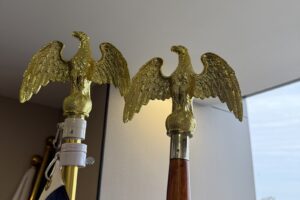
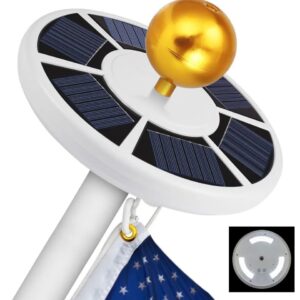
The finial is a small part with a large effect on how an installation reads: a ball, a spear or a market-specific ornament changes the character of the same pole. Finish matters too — anodised, painted or polished — and the finish has to be chosen with the site in mind, because a coastal position will punish the wrong one.
What to send with a flagpole enquiry
Five items remove almost all of the back-and-forth:
- The flag you intend to fly — its size, or the size that has to be visible and from what distance.
- The height you have in mind, or the constraint that sets it (building height, planning limit, the space available).
- The site: open ground, hard standing, a wall, a vehicle, or a boat.
- The finish you want, and whether the position is coastal.
- Quantity and destination, so production and freight can be planned together.
Ordering
Flagpoles are built to order, and the range covers kits as well as single poles — a flagpole kit bundles the pole, the fixings and the flag so nothing has to be sourced separately.
Minimum order quantity depends on the model and on the stock position at the time, so we confirm it against the specific pole rather than quoting a blanket figure. Tell us the model and we will tell you what is available.
Sampling and production times: samples in 1–7 days; stock items ship in 3–7 days; printed or customised work takes 7–12 days; larger volumes run to about 20 days.
Related reading
- Outdoor flagpoles
- Flagpole installation guide (20 ft telescoping)
- Commercial flagpole installation: what buyers specify
- In-ground versus surface-mounted flagpole bases
- How to choose a flag base for outdoor advertising flagpoles
- Flag attachment options: grommets, pole sleeves, D-rings and ties
- Flag fabrics compared: satin, oxford, polyester and nylon
Products in this range: 8 ft · 12 ft · 15 ft · 20 ft fibreglass · 25 ft fibreglass · 30 ft fibreglass · 3 m fibreglass · 6 m · 25 ft telescoping · Titan telescoping · telescoping aluminium · telescopic aluminium · fibreglass telescopic · fibreglass for commercial buildings · fibreglass pole · fibreglass pole for flag · brass · rotating · plastic · wooden · flagpole kits · flagpole accessories