Flagpole Accessories: Match Every Part to the Pole You Have
Most accessory failures are matching failures, not manufacturing faults. A halyard too thick for the sheave groove, a finial spindle that will not seat in the top cap, flag rings clamped on a diameter they were never sized for — all of it is settled at the quotation stage. This guide works through flagpole accessories one part at a time, asking what your pole forces each part to be.
Work in one direction: height, outside diameter and wall thickness first, material and finish second, appearance last. A buyer who picks a finial from a photograph and then hunts for a pole to fit it usually pays for a second production run. Our poles can be customised by height, diameter, wall thickness, material, finish and base, so the accessory set is specified in the same order.
Read the Pole Spec Before You Order a Single Part
These pole facts decide almost every accessory decision. Pull them off the drawing or the pole on site.
- Outside diameter at the top. Sets ring bore, top cap thread and truck clamp. On a multi-section pole the top section counts, not the base.
- Wall thickness. Limits how much thread you can cut into the top section and how much clamp force a truck or bracket applies before the tube deforms.
- Height and section count. Sets halyard length, pulley stations and the load at the truck.
- Material and finish. Stainless steel 201, 304 or 316, aluminium alloy, copper, zinc alloy and some plastics all host accessories, but a powder-coated or anodised surface is easily marked by an over-tightened ring.
- Flag size and sleeve depth. The flag, not the pole, sets ring spacing and the load on each hook.
Halyard: Diameter, Length and Wear Points
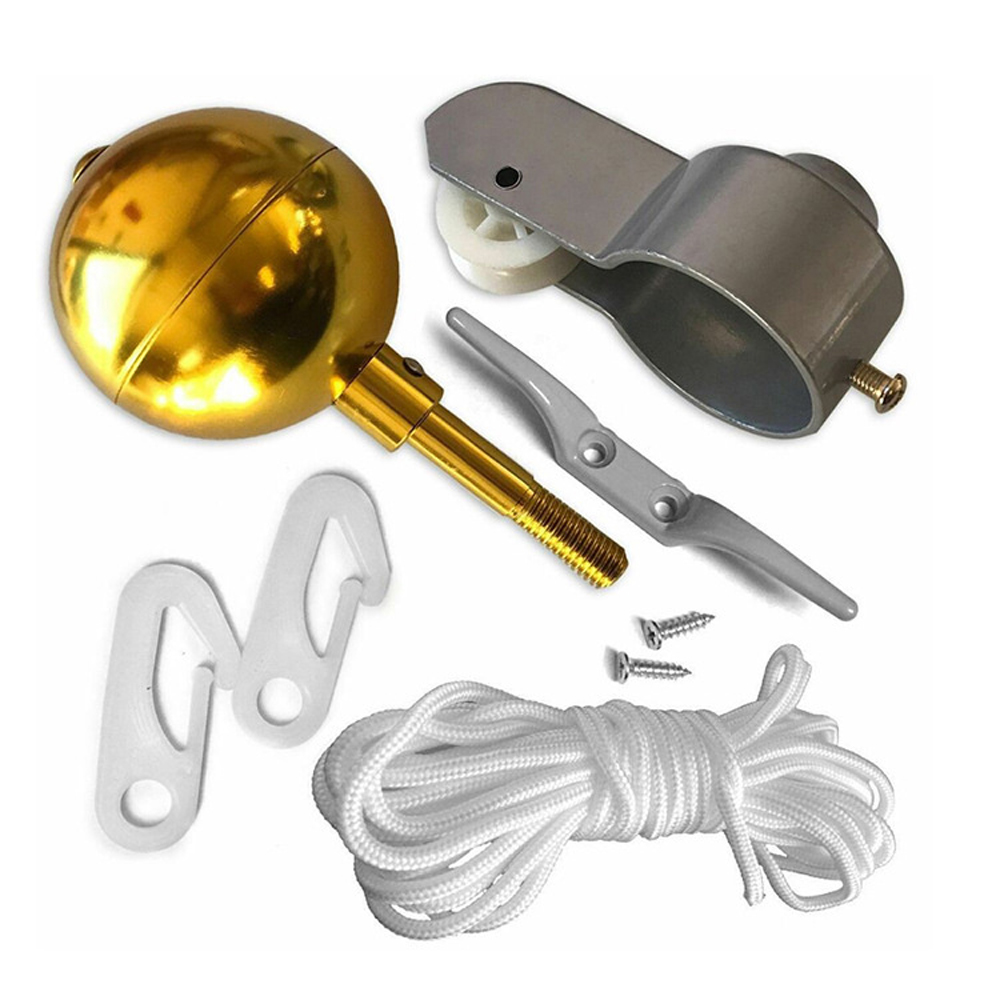
The halyard is the only accessory that moves, so it is the only one that wears. The rope must sit in the pulley groove without bottoming out and without riding the flanges: too thick and it will not run, too thin and it grooves the sheave and cuts into the hand at the cleat.
Length follows pole height plus enough tail to cleat off at a comfortable handling height, so order a finished length with a factory splice rather than a spool to cut on site. Braided synthetic rope holds its shape and resists ultraviolet bleaching; twisted natural fibre takes up water and stiffens. Warning signs: a glazed or furry braid, a stiff set where the rope bends over the truck, bleached colour, or a splice opening up.
Pulley Truck and Top Cap: The Load Path Above the Flag
The truck carries the sheave at the top and takes the whole flag load, doubled at the sheave.
- Clamp against diameter and wall. A clamp that is too large will not grip; over-tightening a thin-wall top section ovalises the tube and binds the sheave.
- Sheave and cap. Moulded polymer sheaves run quietly and do not stain a pole, metal sheaves resist abrasion on dusty sites, and the cap is usually the finial seat, so confirm that thread before clamping.
Warning signs: a squealing or flat-spotted sheave, wear at the axle, the halyard jumping the groove, or pitting around the axle on coastal sites.
Flagpole Finial: Thread Fit, Top Mass and Wind
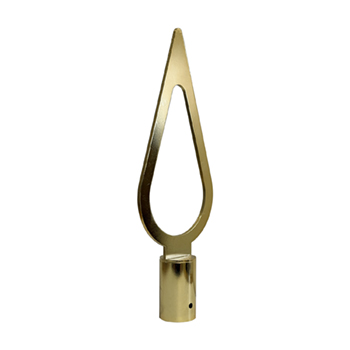
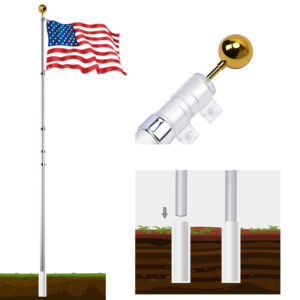
The threaded top ornament is usually zinc alloy, copper, brass-plated metal or stainless steel. Thread fit comes first. The spindle or socket must match the pitch of the top cap, or it will not seat, will cross-thread, or will leave a gap that lets water in. On a thin-wall top section the seat should be a welded or riveted socket rather than a thread cut into the tube.
Mass and wind come second. A heavy ornament on a slim top section adds mass where the pole moves most and loads the truck, and the finial meets the cleanest, fastest air on the pole, so a large ornament behaves like a small sail.
Warning signs: white or green bloom at the thread line, water weeping from the cap, or a finial loose after a season.
Flag Rings, Hooks and Snaps: Sizing to the Mast and Sleeve
Rings are the interface between halyard and flag: one at the head and one at the fly of the sleeve, so the flag hangs on the halyard rather than on the mast.
- Bore against the mast. The ring must clear the mast outside diameter with the flag fitted. Too tight and it wears through a powder coat; too loose and it rattles in wind.
- Eye against the sleeve. Snap hooks and swivel snaps let a flag be changed without untying the halyard, and a swivelling ring takes out the twist a flag builds as wind direction shifts; screw-clamp rings hold a fixed position instead.
Warning signs: an oval bore riding on the coating, clamp screws cutting a coated mast, crazed plastic, frayed halyard strands at the eye.
Flagpole Bracket, Ground Spike and Base: Anchoring Is Its Own Decision
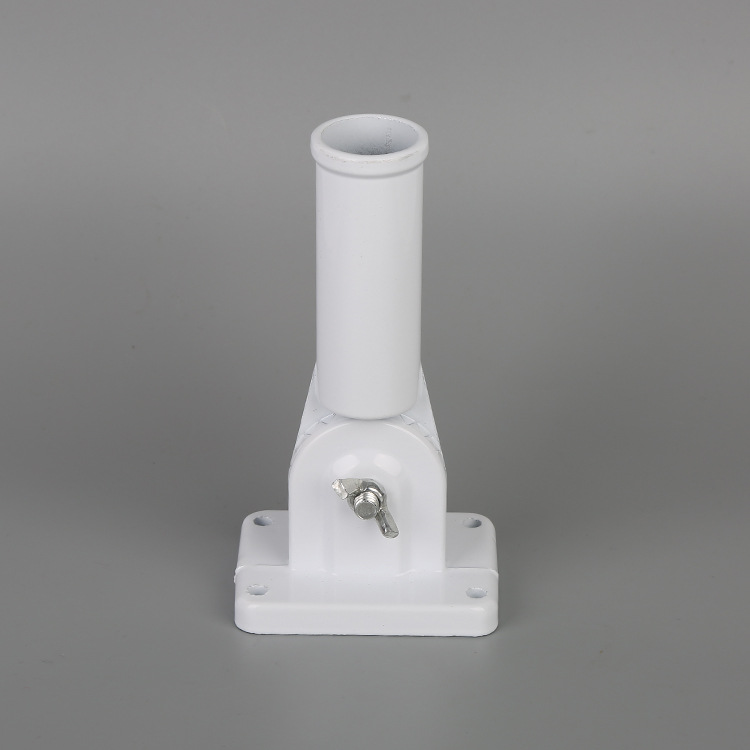
None of these three is chosen from pole height alone.
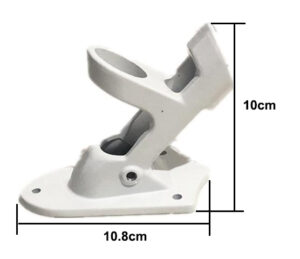
- Flagpole bracket. A wall or surface bracket holds the pole out from a facade at a fixed or adjustable angle. Match socket bore to pole diameter, base plate to substrate, and projection to whatever the pole must clear.
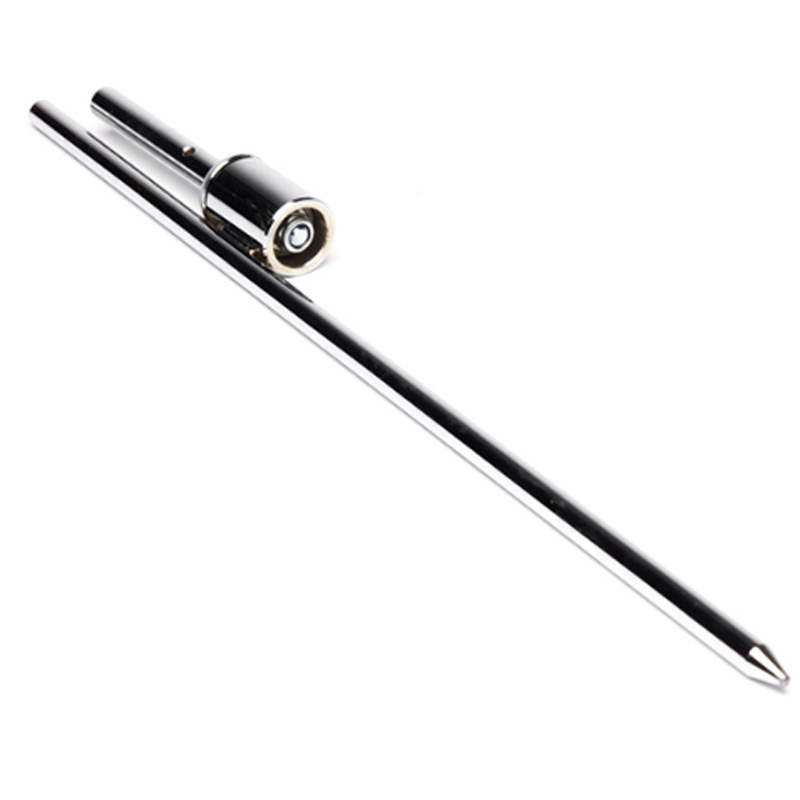
- Ground spike. A drive-in spike suits soil, not pavement. A pole that wobbles after driving usually has a spike too short for the soil, not too light.
- Base. Movable bases run from cast plate to water-fill to weighted discs, supplied in several steps across roughly 1 kg to 12 kg. Match mass and footprint to flag area, wind exposure and the floor it stands on; a base that walks on a hard floor is the wrong base for a flag that catches wind.
Accessory, Match Basis and Failure Signal
Use this table as a checklist: the middle column decides the specification, the right column is the warning sign.
| Accessory | What it must match | Warning sign before failure |
|---|---|---|
| Halyard | Pulley groove diameter, cleat, halyard length | Glazed or bleached braid, stiff set at the truck |
| Pulley truck | Top-section diameter and wall thickness; flag load | Flat-spotted sheave, halyard jumping the groove |
| Top cap and finial | Thread pitch, thread depth allowed by the wall, top mass | Finial loose after a season, water at the thread line |
| Flag rings and snaps | Mast diameter, sleeve depth, halyard diameter | Oval bore riding on the coating |
| Flagpole bracket | Socket bore, substrate, projection and angle | Rotation under load, anchor bolts loosening |
| Ground spike | Soil, embedment depth, pole diameter | Pole wobbling after driving |
| Base | Flag area, wind exposure, floor; mass across 1 kg to 12 kg | Base walking on a hard floor |
Replacement Cycles: What to Stock and When to Swap
Treat the halyard, flag rings or snaps and any polymer sheave as service items: inspect them each season, and keep a spare halyard and ring set for masts rigged all year. After a storm, check the halyard where it bends over the truck, the ring bore at the mast, the anchor point and the spike embedment. The one-year warranty covers defects rather than wear, so keep dates: a record of what failed and when lets you change the specification next time.
How to Order a Complete Matched Set
Send the pole data and we return the accessory list that fits it: pole height, top-section outside diameter, wall thickness, material, finish, flag size and the site condition (indoor floor, exposed facade, soil or coastal salt). That is enough to match halyard, truck, finial, rings, bracket, spike and base in one pass.
Browse the range on our flagpole accessories page, or start from the pole itself: outdoor flag pole for permanent installations, indoor flag pole for reception and showroom masts. Custom accessory specification and private-label packaging run through OEM and ODM.
Every quote states MOQ, tooling and lead time, back within 24 hours. Stock accessories carry no minimum on most lines and ship from a single piece, and artwork-only customisation has no minimum either. A minimum applies only where new hardware such as a pole or a fitting has to be tooled, and it starts at around 500 pieces. Stock orders leave in 3–7 days depending on warehouse availability. Production runs through a pre-production sample, in-process and pre-shipment inspection, with a one-year warranty on every order. Get a Quote with your pole specification and flag size, and ask for the matched accessory list rather than one part in isolation.