How a Wall Mount Flagpole Bracket Fits Into the Whole Assembly
A wall mount flagpole bracket is the small piece of hardware that decides whether a facade display stays stable for years or works loose within a season. The bracket carries the pole, the pole carries the flag, and the flag turns wind into load that travels back down through the bracket into the building.
Most wall brackets are bought together with a wall-mounted pole rather than on their own. Wall-mounted poles are normally supplied in 1.5 m and 1.8 m lengths, and the pole diameter they take is 25 mm or less. Two common examples are 5 ft to 6 ft aluminium wall-mounted flagpoles and 6 ft stainless steel wall-mounted flagpoles. Specifying the bracket and the pole together keeps the bore, the fixing and the flag size in one decision.
Buyers who treat the bracket as a small accessory rather than as part of a structural chain usually meet one of three outcomes: wall damage, a bent pole, or a flag that never hangs the way it was drawn.
This guide follows the decision chain we see in real projects: what the wall is made of, how the fixing is chosen, what angle adjustment can and cannot solve, how flag size relates to wind load, and what to check after installation. It is written for procurement teams, contractors and facility managers who need to specify correctly the first time.
Finished wall-mount brackets are produced in aluminum with either a powder-coated or an anodized surface, and the matching fixings are quoted together with the bracket so nothing is left to guesswork on site. The wider hardware range sits under flagpole accessories, and complete assemblies are listed across our product catalogue.
Step 1: Read the Wall Before You Read the Bracket
The substrate drives everything. A fixing that is correct for a cast concrete column can be the wrong choice for a thin metal panel, and a bracket that is perfectly rigid may still be blamed for a problem that starts in a lightweight cavity wall. Before comparing bracket models, establish what the bracket will actually be bolted to.
| Substrate | Typical fixing approach | What to watch |
|---|---|---|
| Reinforced concrete or solid brick | Mechanical anchors set into the structural mass | Confirm you are drilling into the wall body, not render, plaster or a thin cladding layer |
| Cavity brick or block | Anchors that transfer load past the hollow void | Hollow sections reduce pull-out capacity; the fixing must reach sound material |
| Timber frame or sheathing | Fixing into structural studs or a reinforced backing plate | Screws into sheathing alone will creep and loosen; locate the studs first |
| Metal sheet or composite panel | Through-bolt to the panel frame or a purpose-made backing plate | Thin panels deform locally; spread the load across a wider area |
| Glass curtain wall or stone cladding | Mounting to the mullion or structural frame, never to the finish | Requires coordination with the facade engineer before ordering |
The working rule is simple: specify the fixing to the substrate rather than to the bracket alone. The bracket is sized for the pole and the flag; the fixing is sized for the wall. When a project team sends only a pole length, we ask for the wall build-up as well.
Step 2: What an Adjustable Flagpole Bracket Does, and Does Not Do
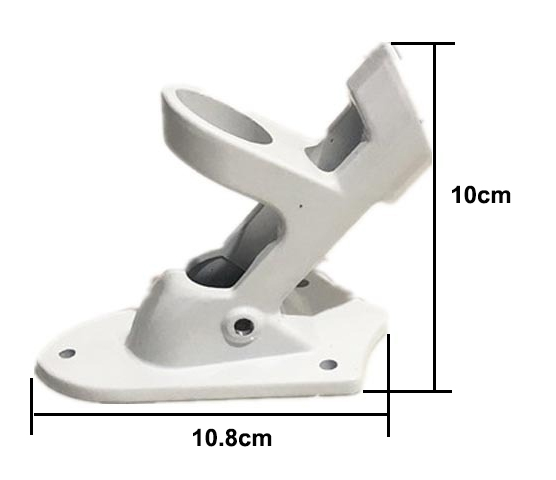
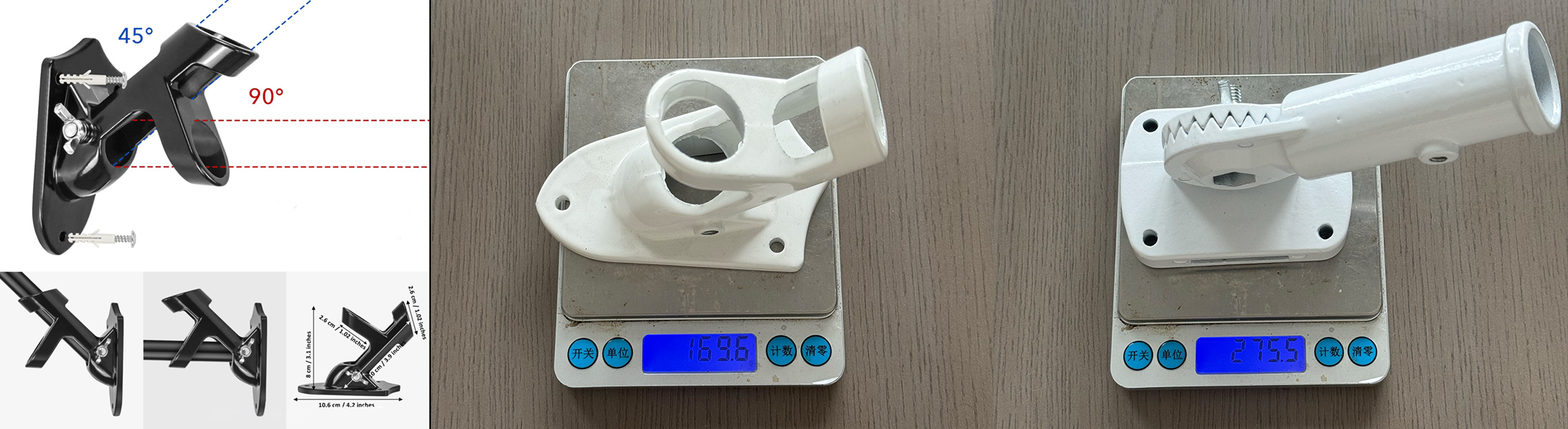
An adjustable flagpole bracket lets the pole be set at an angle instead of being locked in a single position. In practice that helps in three situations:
- Clearing an obstacle. An awning, sign or balcony rail sits in the straight-out path of the pole.
- Controlling presentation. A flag reads better at a slight upward tilt on a high wall, or needs to sit closer to the facade on a narrow street frontage.
- Sharing one mount. A multi-way bracket holds two or three poles from a single fixing point, which matters where drilling positions are limited.
What adjustment does not do is increase capacity. Angling a pole changes the direction of the load path and can add bending where the pole enters the bracket. The safe approach is to treat the adjustable range as a positioning feature, then confirm that the chosen extreme still sits comfortably inside the pole’s working limits. Buyers comparing outdoor flag poles should settle the angle before selecting the pole diameter, not after.
Step 3: Match the Flag to the Mount, Not the Mount to the Flag
Flag area and wind exposure are the two variables most often underestimated. A larger flag on the same pole in the same location multiplies the force the bracket has to resist. With a wall mount there is no ground socket or ballast base to absorb movement, so any flex travels straight into the facade.
Practical guidance for specifiers:
- Keep the flag proportionate to the pole. A flag that is oversized for its pole flogs harder and shortens the life of the whole assembly.
- On exposed elevations such as coastal sites, rooftops and open corners, choose a smaller flag and a shorter pole than you would in a sheltered courtyard.
- Sleeved or fringed flags and banner-style formats behave differently from plain flags, because extra fabric and trim change how the load is applied. The flag and banner range shows the formats involved.
- Where a flag is removed seasonally, plan for that in the bracket choice. Easy service access is worth more than a marginally more compact housing.
If the elevation is genuinely severe, the honest answer may be a different product category rather than a bigger bracket: a ground-set or ballasted free-standing pole, or a tensioned banner system, will usually serve better than a wall-mounted pole pushed beyond its intended role.
Step 4: Installation Checks and Common Failure Modes
Most wall-mount problems trace back to a handful of causes, and nearly all of them are visible during a short post-installation check.
| What you see | Likely cause | Fix direction |
|---|---|---|
| Bracket loosens over a few weeks | Fixing anchored in render, plaster or sheathing instead of structure | Re-fix into the structural layer, or add a load-spreading backing plate |
| Wall cracks radiating from the mount | Concentrated point load, or anchors over-tightened during fitting | Review the fixing pattern and distribute the load |
| Pole bends at the bracket mouth | Flag too large, or pole too slender for the exposure | Reduce flag size, or step up the pole section |
| Flag wraps and will not fly | Pole angle fighting the prevailing wind, or too little clearance from the facade | Re-set the adjustable angle and re-check clearance |
| Finish chalking or dulling | Unprotected edge, or a finish not suited to the environment | Specify powder coating or anodizing appropriate to the site |
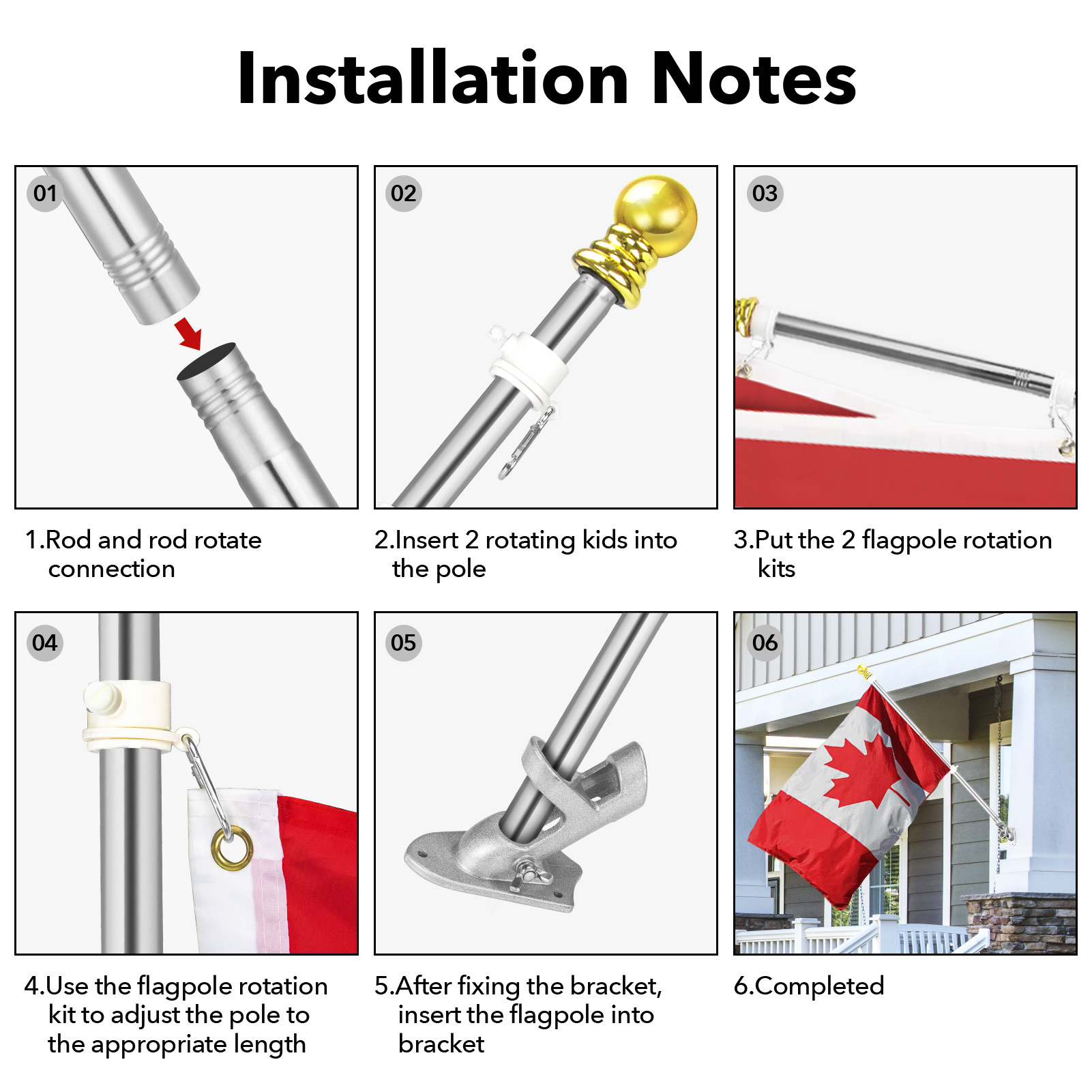
At handover, check four things before the flag goes up: the bracket is level and square to the facade; every fixing is fully seated in sound material; the adjustable joint is locked at the intended angle and moves only when released; and the pole sits fully home in the socket with no rocking. Re-check the fixings after the first period of normal use, then move to a routine inspection cycle.
Materials and Finish: Why Aluminum Suits Wall Mounts
Wall-mounted hardware spends its life exposed on one side and hidden on the other. Aluminum keeps the bracket light, which reduces the load the facade has to carry, while remaining stiff enough to hold a pole without visible deflection. Powder coating gives a durable, colour-matched surface for prominent facades; anodizing gives a harder, more metallic finish for architectural facades and coastal work. Both finishes are available across our adjustable bracket range.
Where the bracket, pole and flag need to be specified as one structural set, send us the elevation and we will quote it as a single package.
Ordering Notes for Procurement Teams
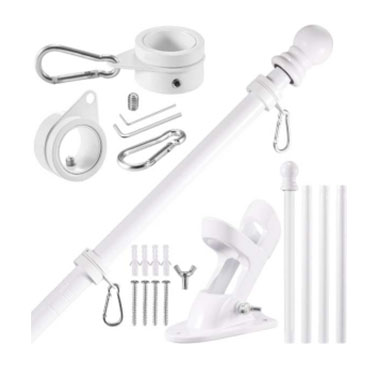
To quote accurately we need four inputs: wall substrate, pole length and diameter, number of poles per bracket, and the flag format and size. A photo of the elevation helps more than a long specification, because it shows clearance, access and exposure at once.
Commercial terms are straightforward. Stock items ship from one piece with no minimum on most lines, and artwork-only customisation carries no minimum. Where new hardware such as a pole or a fitting has to be tooled, a minimum applies and starts at around 500 pieces. In-stock goods are dispatched in three to seven days depending on warehouse availability, quotations covering minimums, tooling and lead time come back within 24 hours, and all hardware carries a one-year warranty. Production follows a pre-production sample, in-process inspection and a pre-shipment check.
Get a Quote for Your Wall Mount Flagpole Bracket
Send your wall build-up, pole size and flag format through the contact form and we will confirm the bracket model, the matching fixings and the delivery schedule for your site. If you are still at design stage, tell us the elevation and we will recommend the configuration before you commit to any drilling positions.