Fabric is the part of a flag quotation that buyers ask about most and understand least, because the names are not ranked in the order people assume. Satin, oxford, polyester and nylon are not four grades of the same thing; they are four answers to different questions.
And the question underneath them — “how heavy is it?” — is usually asked in a way that cannot be answered usefully. Fabric weight alone does not tell you how long a flag will last. A heavier cloth on a badly finished flag will fail sooner than a lighter cloth on a properly built one. This guide covers both halves of that: the fabrics, and the construction that has to go with them.
Three jobs every flag fabric has to do
- Show the design. The print has to sit on the surface, survive being folded, and hold its colour after sun and washing.
- Survive the conditions. Wind, abrasion against the pole, salt, UV and rain. An outdoor flag is a moving, flapping object under constant mechanical load.
- Behave correctly for where it hangs. Outdoors, a flag should fly and shed air. Indoors, it should hang straight, hold a fold and catch the light. These two requirements pull in opposite directions — which is why the indoor tier exists at all.
Polyester — the general-purpose outdoor flag
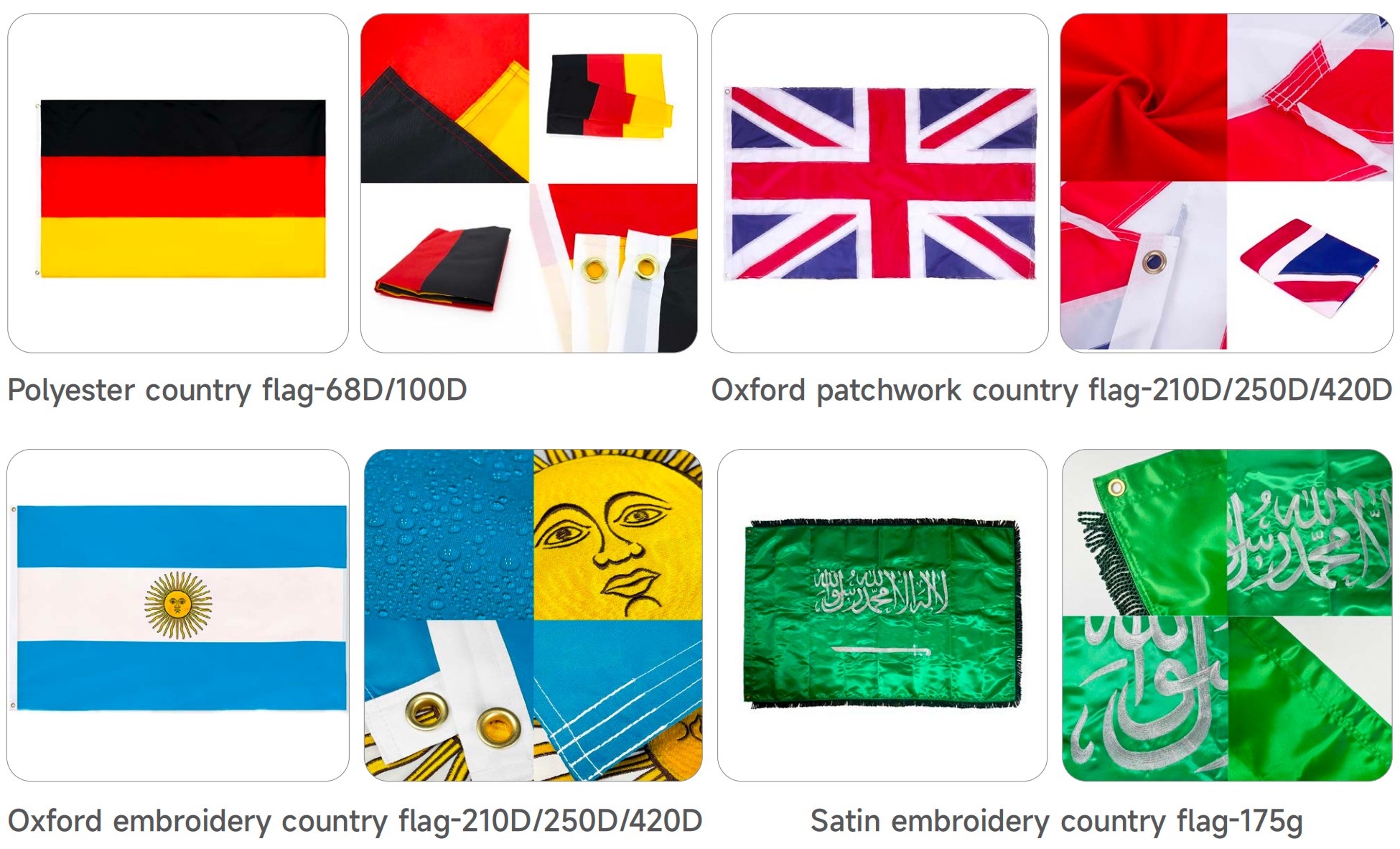
The default choice for most outdoor flags. It takes print well, resists UV reasonably, and has enough body to fly without flogging itself to pieces. If a buyer has no specific requirement, polyester is usually the right answer, and it is what most of our standard outdoor flags are made in. We build polyester country flags in 68D and 100D.
Nylon — when weight and brightness matter
Nylon is lighter for the same area, which means a smaller breeze will lift it and it dries faster after rain. It also takes colour brightly, which is why it is often chosen where the flag has to look vivid. The trade-off is that a lighter fabric works harder in strong conditions, so it suits positions where light air matters more than heavy weather.
Oxford — where cost matters and the flag is short-lived
Oxford is a heavier plain weave. It is widely used where the flag is a consumable rather than an object: promotional periods, one-off events, high-turnover sets. It is a sensible answer to “we need two hundred of these for a campaign” and a poor answer to “this has to look correct in a boardroom”.
We build oxford country flags in two constructions:
- Oxford patchwork — the design built from joined panels, in 210D, 250D and 420D.
- Oxford embroidery — the design embroidered rather than printed, in the same 210D, 250D and 420D weights.
Satin — the top tier, and indoor only
Satin is the highest of the four, and we recommend it for indoor use only. It is the ceremonial tier: the fabric chosen where a flag is judged on how it hangs, how it holds a pleat and how its colour reads under interior light rather than on how it performs in weather. Ceremonial and VIP applications, framed or floor-standing display sets and indoor protocol flags are the satin use case.
Do not specify satin for outdoor display. It is not built to take continuous wind load, and the finish that makes it look right indoors is exactly what weather degrades.
Our satin embroidery country flags are built at 175 g.
Weight, denier and construction: what the number does and does not tell you

Two flags can both be described as “polyester” and behave completely differently. That is why we build in a range of weights — 80 g, 110 g, 150 g, 220 g and others — and why we quote the denier or the gram weight of the specific construction rather than a single figure for the material.
| Construction | What we build in |
|---|---|
| Polyester country flag | 68D / 100D |
| Oxford patchwork country flag | 210D / 250D / 420D |
| Oxford embroidery country flag | 210D / 250D / 420D |
| Satin embroidery country flag | 175 g |
Weight changes four things at once:
- How the flag flies — a heavier cloth needs more air before it lifts.
- How it wears — a heavier weave resists abrasion against the pole and the halyard.
- How it hangs indoors — weight is what makes a flag fall straight instead of curling.
- What it costs, and how it packs — which matters once the order is a container rather than a parcel.
But for a flag that will be flown continuously, weight is only half the answer. Long-term outdoor hanging calls for a heavier cloth *and* special reinforcement of the seams and the heading — the stitching, not the fabric, is where a hard-used flag usually fails first. This is why a gram figure quoted on its own is not a meaningful specification: two flags at the same weight, sewn differently, will have very different service lives. Tell us the position, how long the flag has to last, and we will specify the weight *and* the construction together.
For a one-off event, none of this applies. Use 80 g polyester — it is the cheapest option, and a single-use banner does not need to survive a season. Specifying a heavier cloth for an event is money spent on nothing.
Size and proportion
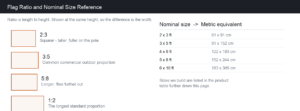
Fabric choice also interacts with size. A large flag made in a light cloth puts more load on its fixings than the same flag in a heavier one, and an unusually long or narrow flag behaves differently again. There is no fixed size rule — sizes can be paired to the job, and the standard proportions and sizes for national flags are set out in our flag size and ratio reference.
Finishing: how the fabric meets the pole
The finishing is decided partly by where the flag hangs:
- Pole sleeve — a full-height fabric channel, which produces a straight hanging edge and is the usual indoor choice.
- Grommets — reinforced eyelets along the heading, for flags tied to a halyard or a frame.
- Ties and D-rings — for specific fixings and for quick removal.
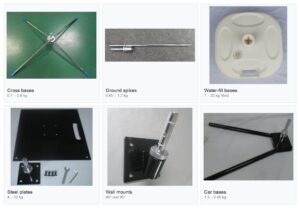
Each is available to order, and on a hard-used flag the finishing is where the reinforcement mentioned above is actually applied. What each one is for, and where each fails, is covered in our flag attachment guide.
Matching fabric to the job
| Fabric | Outdoors | Indoors | Chosen when |
|---|---|---|---|
| Polyester | Yes | Yes | General-purpose outdoor flag; the sensible default. 68D / 100D |
| Nylon | Yes | Yes | Light air, quick drying and vivid colour are the priorities |
| Oxford (patchwork or embroidery) | Yes | Yes | Cost matters and the flag is short-lived or high-turnover. 210D / 250D / 420D |
| Satin (embroidery) | No — indoor only | Yes | Ceremonial and VIP display, where drape and colour are the point. 175 g |
What to send with a flag enquiry
Four items are enough to quote accurately:
- Where the flag will hang — outdoors, indoors, on a vehicle, on a boat.
- The size, or the size that has to be visible and from what distance. If it is a national flag, tell us the country and we will propose the correct proportions.
- How long it has to last — a single event and a permanent installation do not call for the same fabric *or* the same construction.
- Quantity and destination, so production and freight can be planned together.
Ordering
We produce in all four fabrics, in the weights each is available in, and can produce any country’s flag — including mixed-country sets in a single order.
Minimum order quantity: for national flags of popular countries there is no minimum order quantity. For custom-designed flags the minimum is 100 pieces. Tell us which countries you need and we will confirm stock.
Sampling and production times: samples in 1–7 days; stock items ship in 3–7 days; printed or customised work takes 7–12 days; larger volumes run to about 20 days.
Related reading
- Flag sizes and common ratios reference
- Flag attachment options: grommets, pole sleeves, D-rings and ties
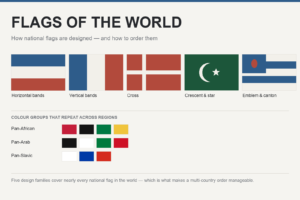
- Flags of the world: how national flags are designed
- Custom flag printing methods
- Flagpole height and material: how to choose
- Flags and banners range
Products in this range: satin flag · satin Saudi Arabian flag · custom nylon flags · custom polyester flags · oxford Gadsden flag · oxford Union Jack · national flags · 3×5 American flag · flags 3×5 ft · American 3×5 flag · large feather flags · custom advertising beach flags · hand flags for marine and boats