Feather Flag vs Teardrop vs Knife Flag: The Short Answer
Shape decides more than artwork. For promotional flags, a feather flag is the right default when you need height, motion and long-distance visibility. A teardrop banner is the right default when floor space is tight and you want a tidy, symmetrical silhouette. A knife flag is the right default when the message has to read as a flat, sign-like panel carrying long lines of text.
Everything else — pole height, wall thickness, fabric weight, base type — is downstream of that decision. This guide follows the sequence a supplier would use: scene, booth footprint, viewing distance, wind exposure, mounting. Standard feather and beach flag pole heights start at 2.8 m and climb through 3.4 m, 4.5 m and 5.5 m. DISITU (Chengdu Disitu Technology Co., Ltd.) has manufactured this range since 2012 and ships to around 90 countries from a 2,000 m² warehouse.
Three Flag Shapes, Three Jobs
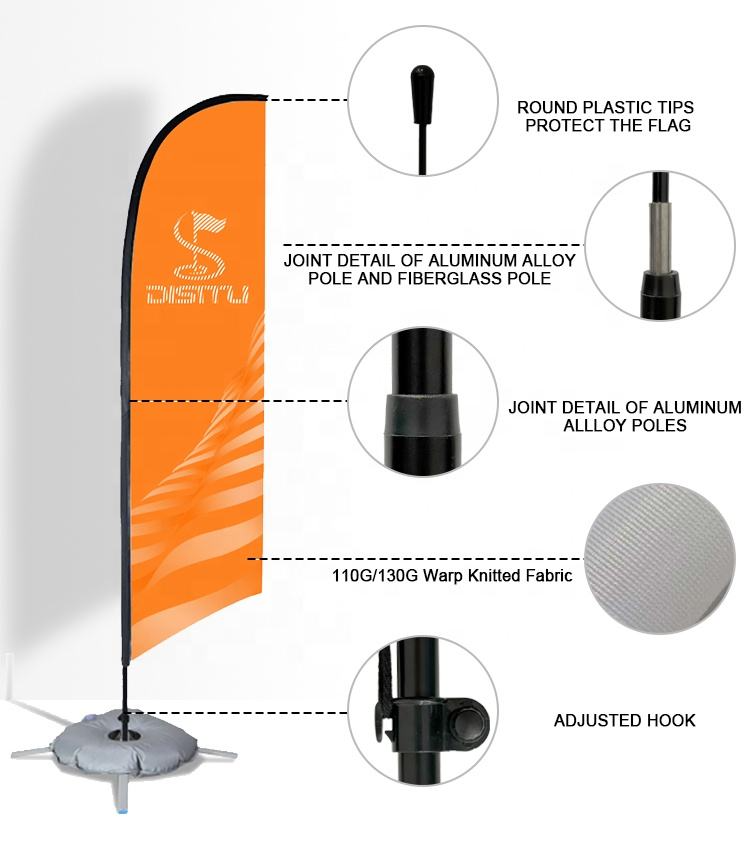
Feather flag. The leading edge is curved and the top tapers to a point, so the printed surface narrows as it rises. The eye reads that taper as movement — which is what makes a feather flag legible from a passing vehicle. Because the silhouette sits low and the tip is light, the banner trails in gusts instead of fighting them.
Teardrop banner. A rounded, near-symmetrical top gives the teardrop a solid, filled look that reads as calm rather than urgent. The fabric is tensioned between the pole and a top arm, so the shape holds its profile instead of curling away. Teardrops suit pairs or rows at an entrance or in a retail doorway where the viewer stands 2–10 m away. The trade-off: a filled face holds more wind, which puts more demand on the base.
Knife flag. Straight side edges and a squared top make the knife flag behave like a vertical blade sign — a rectangular face with no curve to design around. It handles logo-and-text layouts and price boards better than the other two shapes, because the full panel width is available top to bottom. The cost is structural: a flat panel presents its whole area to the wind, so a knife flag needs the stiffest pole and the heaviest base of the three.
Feather Flag vs Teardrop vs Knife Flag: Comparison Table
| Shape | Best scene | Visual character | Wind behaviour | Common pole heights |
|---|---|---|---|---|
| Feather flag | Roadside, forecourt, sports events | Curved blade tapering to a point; reads as motion | Trails and sheds gusts; light tip | 2.8 m / 3.4 m / 4.5 m / 5.5 m |
| Teardrop banner | Booth entrance, doorway, reception | Rounded symmetrical top; stable, photographic silhouette | Holds a filled face; needs a weighted base | 2.8 m / 3.4 m / 4.5 m / 5.5 m |
| Knife flag | Event signage, price boards, dense venue rows | Straight rectangular panel; sign-like, maximum usable width | Flat face takes the full load; stiffest pole and base | 2.8 m / 3.4 m / 4.5 m / 5.5 m |
Choosing by Viewing Distance and Booth Footprint
Work backwards from where your customer will stand. Under 3 m, a knife flag on a 2.8 m pole keeps text legible in a dense hall. Between 3 m and 10 m — the range covering most booth approaches and shop entrances — a teardrop banner on a 3.4 m or 4.5 m pole gives the cleanest read. Beyond 10 m, or whenever the viewer is moving, feather flags on 4.5 m and 5.5 m poles are the sensible option: the extra height lifts the message above tents, vehicles and crowds.
Footprint matters too. A teardrop needs the smallest ground area for a given height because the pole is vertical and the base sits directly under it. A feather flag sweeps a longer arc when wind pushes the banner sideways, so leave clearance behind it. Knife flags need a heavier base to resist the flat panel. Plan one base-plus-clearance zone per flag rather than crowding several onto one footprint.
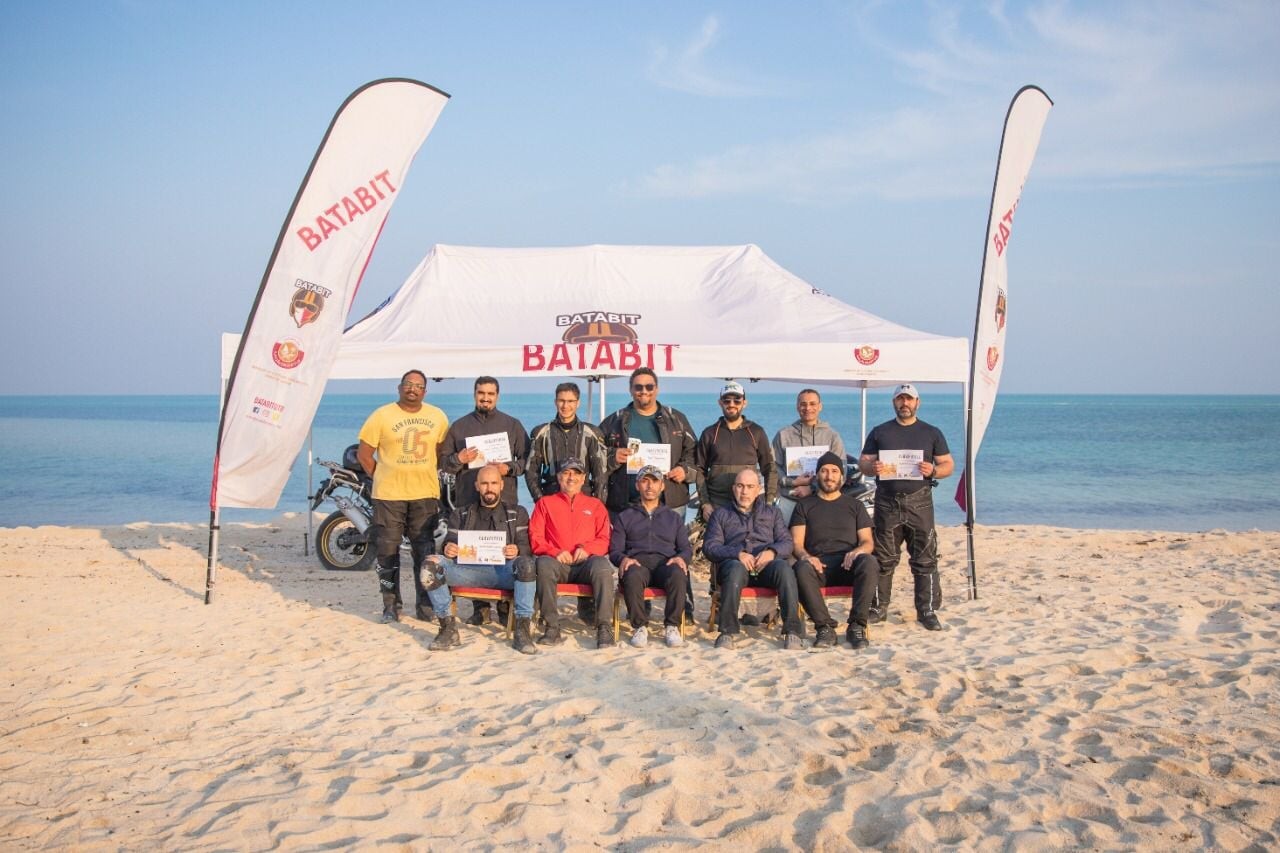
Wind Load: Shape, Fabric and Pole Behaviour
Wind is the variable buyers most often underestimate. Three things decide how a display behaves: the shape’s attitude to airflow, the fabric weight, and the pole stiffness.
Shape first. Curved and tapered flags spill air off the leading edge, so load builds gradually. Flat panels catch the whole face at once, which is why a knife flag behaves as if it were a wind class heavier than a feather flag of the same height. Where a supplier quotes a wind rating, it is worth knowing what it refers to. Beach flag poles are rated on the common Beaufort wind scale, the everyday 0–12 wind force grade: an aluminium-and-fibreglass pole is rated to around wind force 4–5, and an all-fibreglass pole to around wind force 10. Fabric next: we make flags in polyester, nylon, oxford, satin and mesh, in weights from 110 g to 600D. Heavier constructions hold print detail and shape longer in constant wind. Mesh is the usual answer on very exposed sites, because air passes through instead of loading the pole.
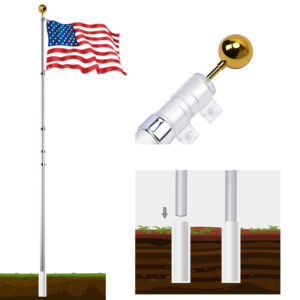
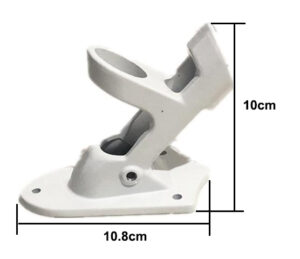
Then the pole. Rod diameter, wall thickness and material decide whether the display bends and recovers or simply fatigues. On exposed sites, specify pole and base together with the flag — the flagpole accessories range lists the spikes, bases and hardware that match each pole diameter.
Mounting: Ground Spike, Cross Base or Vehicle
| Mounting | Surface | Typical shape match | Notes |
|---|---|---|---|
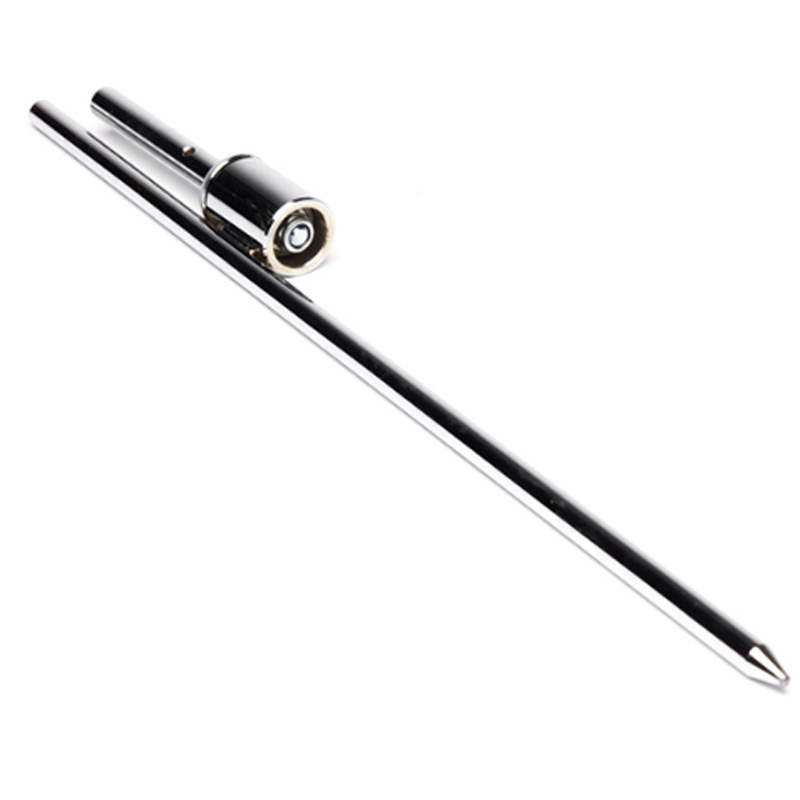
| Ground spike | Soil, grass, sand, gravel | Feather flag | Fastest install; stability depends on soil density and driven depth |
| Cross base with water bag or iron plate | Concrete, tile, indoor floors | Teardrop banner | No ground penetration; the counterweight is the anchor |
| Cross base with vehicle mount | Mobile promotion, parades, route work | Feather flag | Check local road rules before fitting anything to a vehicle |
Two practical rules. On hard ground a spike is useless; on soft sand a bare cross base is worse — match the anchor to the surface, not to the flag. And if a display stays up for weeks, inspect base and pole joints periodically: joints loosen before poles break, and a loose joint makes a banner flap and print wear. The outdoor flag pole pages cover long-run and permanent installations.
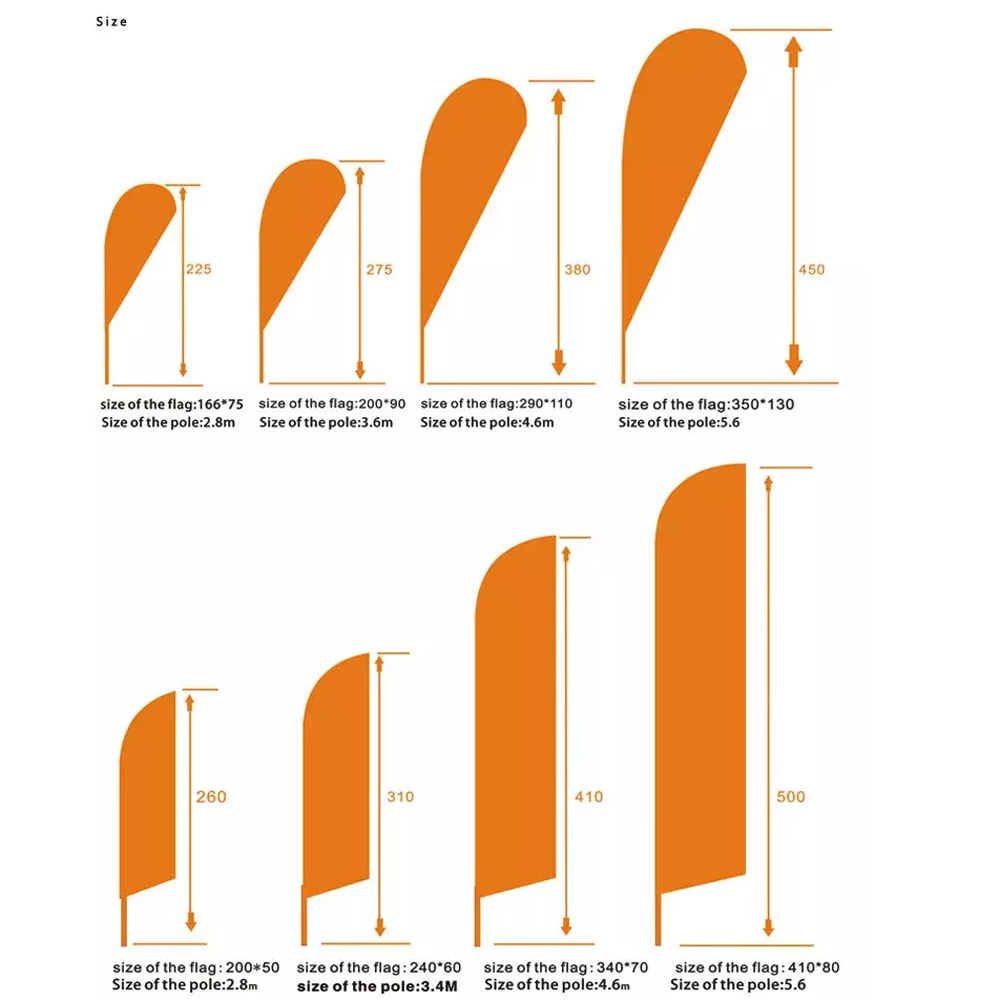
Sizing a Feather Flag: the 2.8 m to 5.5 m Ladder
Feather and beach flags are specified by pole height, and the four working heights are 2.8 m, 3.4 m, 4.5 m and 5.5 m. Two rules keep the choice simple:
- 2.8 m and 3.4 m — indoor halls, booth edges, doorways and shopfronts; comfortable reading up to roughly 8–10 m.
- 4.5 m and 5.5 m — outdoor promotion, forecourts, event perimeters and roadside; chosen when the flag must clear tents, vehicles or a crowd.
Print and finishing carry most of the differentiation. Flags can be printed single- or double-sided, with overlocked edges, a flag sleeve, eyelets or a combination. Poles are specified by height, diameter, wall thickness, material and surface finish, with hoist rope and base options. Edge treatment, sleeve dimensions and eyelet spacing are specification lines too, and they should be locked down before production, not after. If you are building a programme across shapes, the flag and banner range shows how one artwork mounts across formats, and custom work runs through OEM and ODM.
What to Send for a Quote
Quotes come back fastest when the brief is complete: shape and pole height, quantity, fabric and weight, print sides, edge treatment, sleeve or eyelets, and base type. Stock lines carry no minimum on most items and can be ordered from a single piece, and artwork-only customisation has no minimum either. A minimum applies only where new hardware has to be tooled — poles, fittings and similar — and it starts at around 500 pieces. Stock products are dispatched in 3–7 days depending on warehouse availability, artwork-customised lines such as beach flags take around 7–12 days, large production runs around 20 days, and pre-production samples 1–7 days depending on complexity. Quotations covering minimums, tooling and lead time are returned within 24 hours.
Payment runs through T/T, Western Union, PayPal, Visa or L/C, on 30% deposit with 70% against a bill of lading copy, and every order carries a one-year warranty. Shipping is by express, air or sea, with door-to-door delivery available in most countries. Production is controlled through a pre-production sample, in-process inspection and pre-shipment inspection, so a mixed order of feather, teardrop and knife flags is produced and checked as one programme.
Get a Quote for Your Flag Programme
Send your scene, the viewer distance, the mounting surface and the artwork, we will recommend the shape and pole height that fits and return MOQ, tooling and lead time within 24 hours. Start at the contact page and attach your logo file; if you are still comparing formats, order one sample of each shape and test them on site before committing to a production run.