Repeat orders are the least dramatic work a factory does, and the most revealing. Nothing has to be invented; everything has to match.
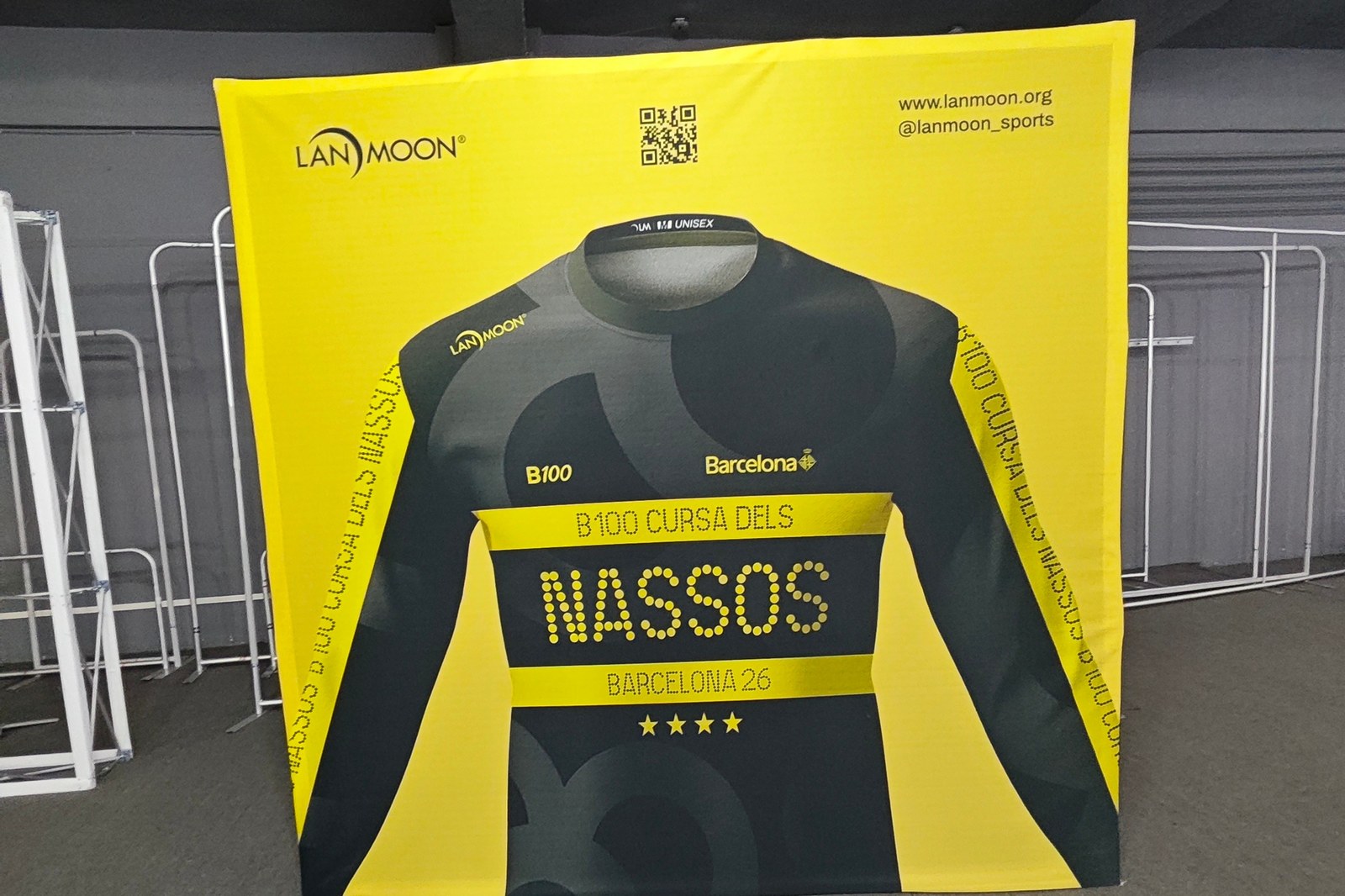
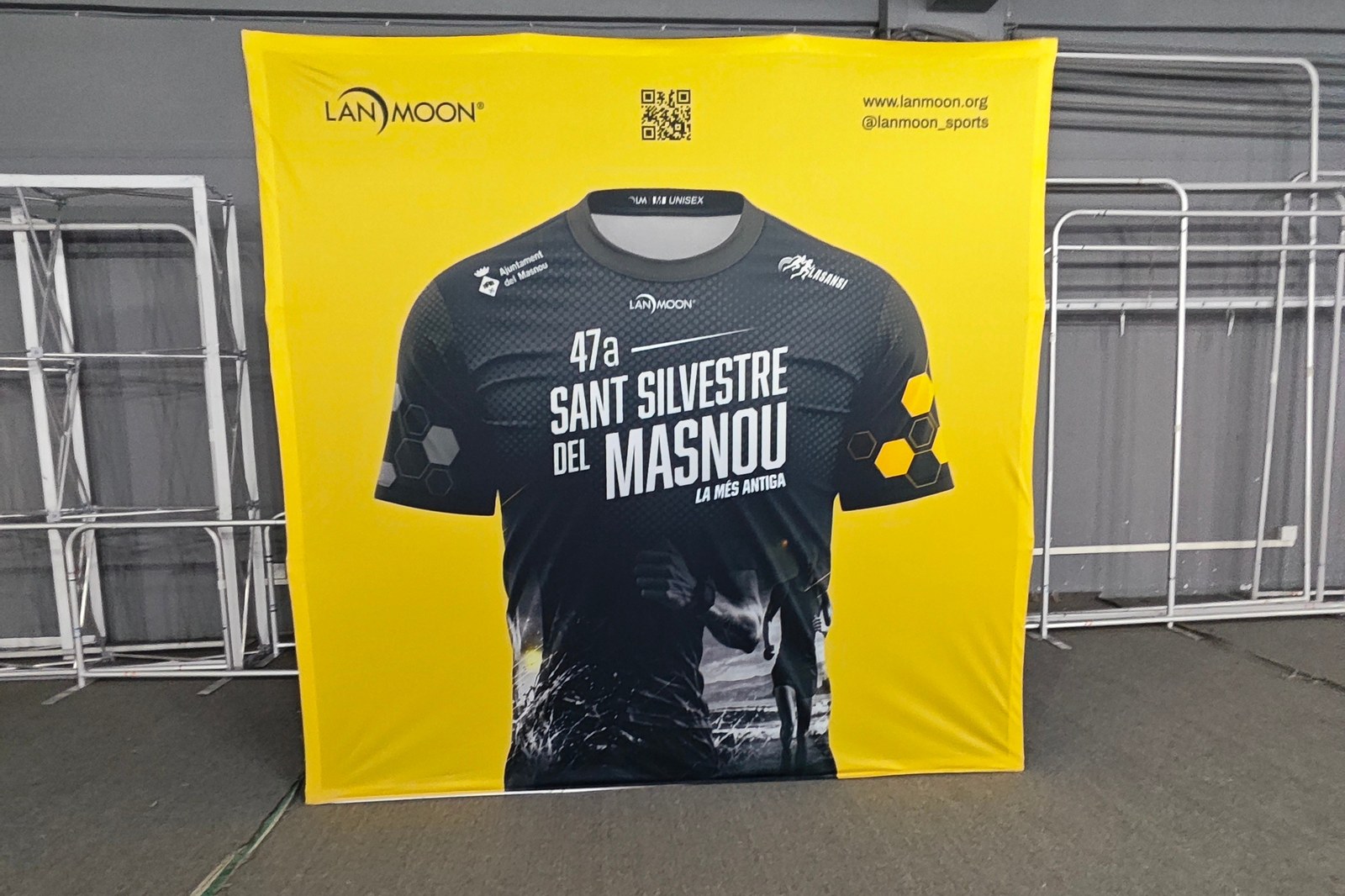
This is the second order from a race organiser in Spain. The first season’s kit worked, so this year they came back with two events on the calendar — the Cursa dels Nassos in Barcelona and the Sant Silvestre del Masnou — and the same four formats: a pop-up display for the registration area, mesh banners for the course, teardrop flags carried by the pacers, and hand flags for the finish.
Same specifications. New artwork. That is the whole brief, and it is harder than it sounds.
Project at a glance
| Item | Specification | Quantity |
|---|---|---|
| Pop-up display frame | Straight 230 × 230 cm; 13 mm square tube, 1.2 mm wall; aluminium; clip connectors; oxford carry bag | Frame reused across seasons |
| Display graphics | Front and back 234 × 234 cm; left, right and top strips 234 × 38 cm; warp-knit with hook-and-loop; front + back + two sides + top per set | 2 designs (Nassos, Masnou) |
| Mesh banners | 2 × 0.8 m; 120 g mesh; single-sided print; hemmed all round; brass grommets at standard spacing | 40 black + 70 yellow |
| Pacer backpack flags | Teardrop 55 × 105 cm; 110 g warp-knit; double-sided print; luxury backpack 50 × 36 × 4 cm; carry bag | 2 sets per design |
| Hand flags | 80 × 120 cm; 110 gsm warp-knit; double-sided print; double-stitched hem; pole sleeve for guide pole | 5 black + 5 yellow |
What a repeat order actually tests
On a first order, the client judges the result. On a repeat order, they compare it — against the kit they already own, in the same photographs, on the same street.
Three things have to hold:
- The colour. The yellow in this set sits next to last season’s yellow on the same start line. Same ink, same fabric, same profile, or the difference is visible in every photo.
- The dimensions. A 234 × 234 cm graphic has to fit a frame bought two seasons ago. Nothing about the frame changed, so nothing about the graphic may change.
- The hardware. Frames, bags and fittings are reused. Only the printed parts are replaced, which is also why the second order costs less to produce than the first.
The display: 230 × 230 frame, 234 × 234 graphic
The frame is a straight pop-up: 230 × 230 cm, 13 mm square aluminium tube with a 1.2 mm wall, joined by clip connectors, packed in an oxford bag. It is the workhorse of race registration areas — light enough for two people to carry, rigid enough to stand square after a season in a van.
The graphic is deliberately larger than the frame: 234 × 234 cm for the faces, and 234 × 38 cm strips for the left, right and top. The extra centimetres wrap around the frame edge and attach with hook-and-loop, which is what stops a pop-up from looking like a poster pinned to a tent. The strips are not decoration; they are the difference between a flat panel and a built wall.
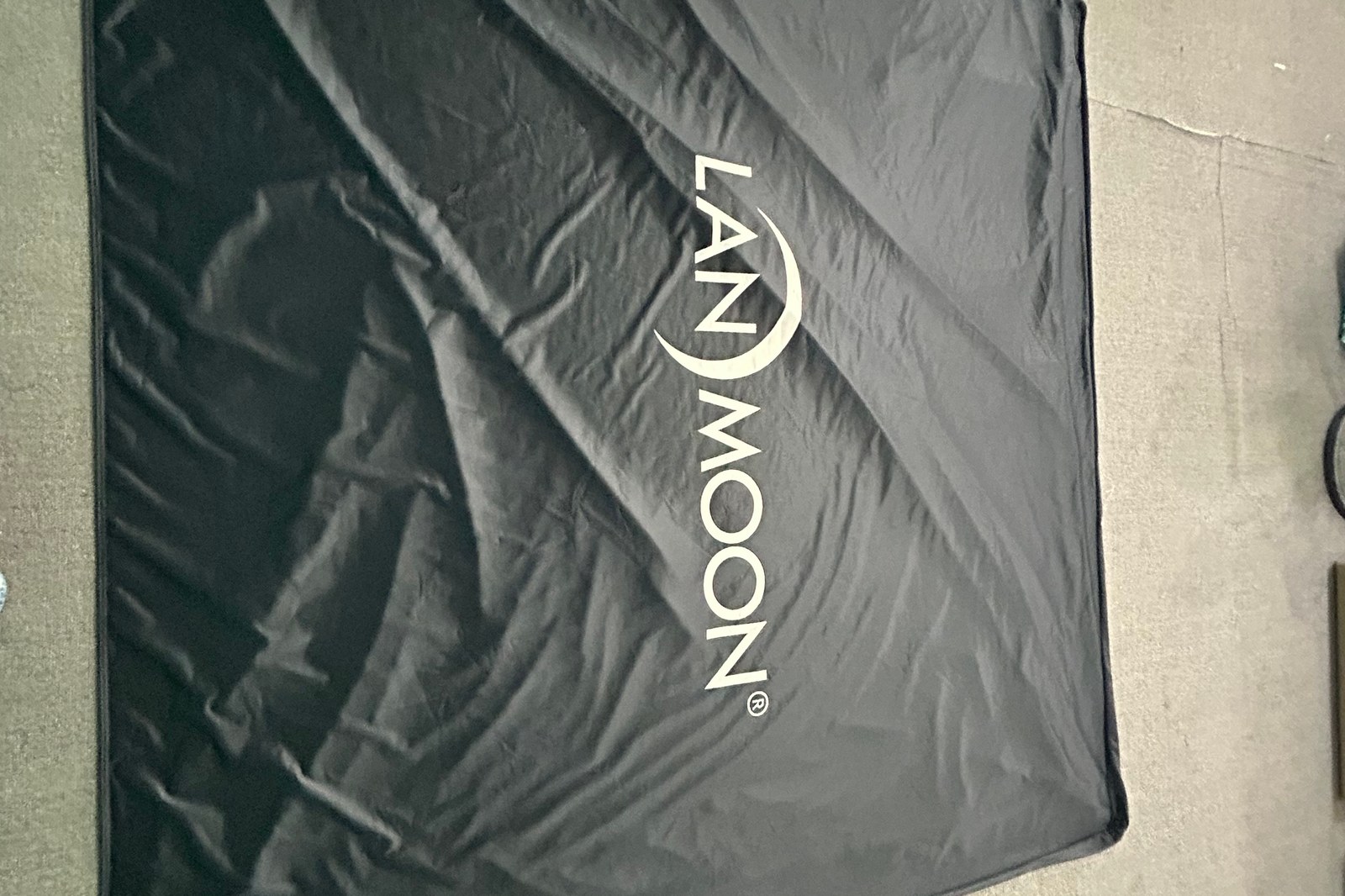
Both faces are printed. From the front it is the race identity; from the back it is the brand mark on a dark field, because the back of a registration display is what the queue looks at for twenty minutes.
110 banners, 40 black and 70 yellow
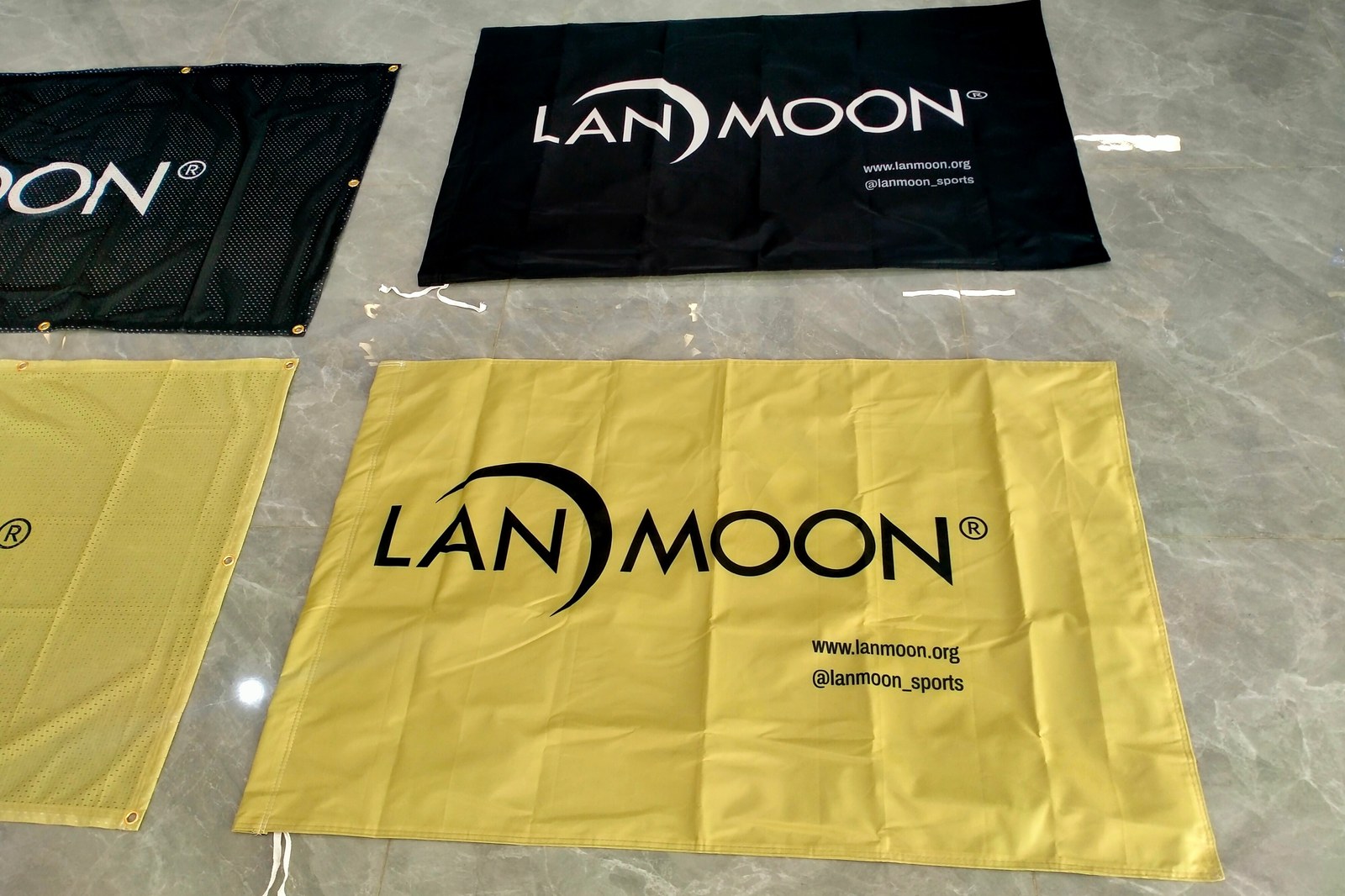
The banners are 2 × 0.8 m, printed on 120 g mesh, single-sided, hemmed on all four sides and fitted with brass grommets at standard spacing. Mesh is the right choice for anything that goes on a course barrier: wind passes through it, so the banner does not act as a sail, and it does not tear at the eyelets on a gusty morning.
The colour split — 40 black, 70 yellow — is a race-day decision, not a print decision. Yellow reads at distance and in low winter light; black disappears against barriers and clothing. A course that needs 110 banners needs most of them to be seen from 50 metres, and that is what the ratio encodes.
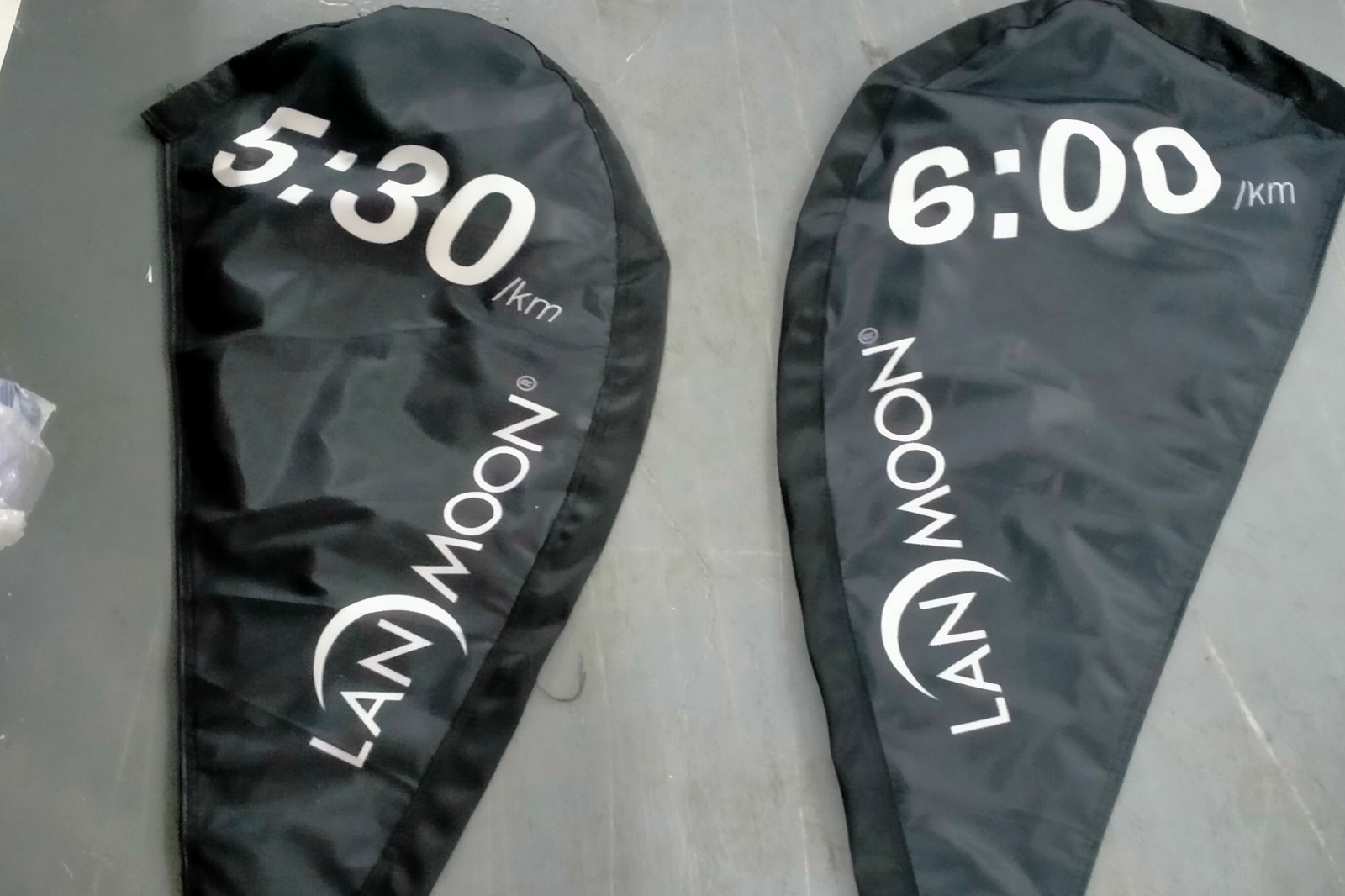
The pacer flags: 55 × 105 cm on a 50 × 36 × 4 cm backpack
These are the smallest printed items in the order and the ones with the strictest brief. A pacer wears one for the length of a race, so the flag has to be light, stable at running pace, and readable from both sides — runners approach from behind and pass on either side.
The specification is a teardrop 55 × 105 cm in 110 g warp-knit, printed on both faces, mounted on a luxury backpack of 50 × 36 × 4 cm with its own carry bag. Two sets per design, because the 5:30 and 6:00 pace groups each need a leader and a sweeper.
Double-sided printing matters more here than anywhere else in the order. A single-sided flag reads as a reverse image from the front, and a pace time read backwards is worse than no pace time at all.
The hand flags: 80 × 120 cm
Ten hand flags — five black, five yellow — at 80 × 120 cm, 110 gsm warp-knit, printed on both sides, double-stitched around the perimeter, with a sleeve sized for a guide pole. These are the finish-line and photo flags: the ones spectators hold, and the ones that end up in the background of every finisher’s picture.
The sleeve, not the grommet, is the right attachment here. A hand flag is waved, not tensioned; a pole sleeve keeps the flag from wrapping around the pole, and double stitching is what survives an hour of waving.
What stays constant on a reorder
The value of a repeat order is not the discount. It is that the second run inherits every decision from the first: the panel plan, the colour profile, the grommet spacing, the strip widths on the display, the bag dimensions. Nothing is re-sampled, nothing is re-approved, and the two seasons’ kit can stand side by side without the difference showing.
If you are reordering event branding, send four things: the previous specification sheet or purchase order, the new artwork, the quantity split by colour, and the date the kit has to be on site. The rest is already decided.
Products used in this order
- Backdrop display stand — the 230 × 230 cm pop-up frame with printed front, back, side and top panels
- Beach teardrop flag set — the 55 × 105 cm double-sided pacer flags
- Backpack flag pole — the 50 × 36 × 4 cm carrier worn by pacers
- Hand-held stick flags — the 80 × 120 cm finish-line flags
Related reading
- Pop-Up Backdrop Size Guide: Choosing the Right Width
- Roll-Up Banners vs X-Banners vs Pop-Up Displays
- Four Branded Canopy Tents for a Race-Weekend Activation
- Custom Flag Printing Methods: Which Process for Which Fabric
- Flag Attachment Options: Grommets, Pole Sleeves, D-Rings and Ties