What a Marine Boat Flag Has to Do Onboard
A marine boat flag is a working product, not a souvenir. It has to stay legible in salt air, hold its colour through a full season of UV, and keep its hoist edge intact when the wind gets up. Choosing one is therefore a specification exercise: fabric first, then print method, then size, then the rigging that holds it in place.
This guide works through those four decisions in order and finishes with the compliance and care points that keep a flag set serviceable. It is written for owners, fleet buyers, and club officers who need to order once and order correctly, whether they are fitting a single cruising yacht or standardising flags across a charter fleet.
Fabric Options and How They Age in Salt Air
Four fabric families cover almost every marine requirement. Woven polyester is the workhorse: it holds a good balance between durability and weight and resists sun and saltwater well. Nylon is lighter, dries fast, and flutters at lower wind speeds, which makes it attractive for signalling; the trade-off is stretch, so it needs a well-reinforced hoist. Canvas is heavier, stronger, and more abrasion-resistant, which suits larger vessels where a flag may rub against rigging, but it dries slowly. Vinyl and rigid panels are used where the flag must stay flat and readable, such as a diver-down marker.
| Fabric | Handling in wind | Drying | Where it earns its place |
|---|---|---|---|
| Woven polyester | Holds shape, moderate weight | Moderate | Ensigns, courtesy flags, everyday display |
| Nylon | Light, flies early, stretches | Fast | Signal flags, small boats, inland sailing |
| Canvas | Heavy, low flutter | Slow | Large vessels, ceremonial use |
| Vinyl or rigid panel | Rigid, no flutter | Immediate | Diver-down and safety signals |
If the flag will be up for months at a time rather than hoisted for an afternoon, weight the decision towards UV resistance and edge strength rather than light weight.
Print Method, Ply, and Edge Reinforcement
Two print routes dominate custom marine flags. Single-ply printing puts the image on one face and shows through in reverse; it is light, economical, and fine for flags read from one side. Double-sided printing builds an image on both faces so the design reads correctly from either side, which is what most club and sponsor flags need. In both cases specify the ink or dye system as marine-grade, so that sunshine and salt spray do not turn a bright field into a pale one.
Construction details decide service life. Look for double-stitched hems, reinforced fly ends, and a heavy hoist with either brass or stainless grommets, or a sewn sleeve where the flag will be slipped onto a staff. These are inexpensive line items that prevent the two most common failures: a blown fly end and a torn hoist corner.
Sizing a Marine Boat Flag to the Vessel
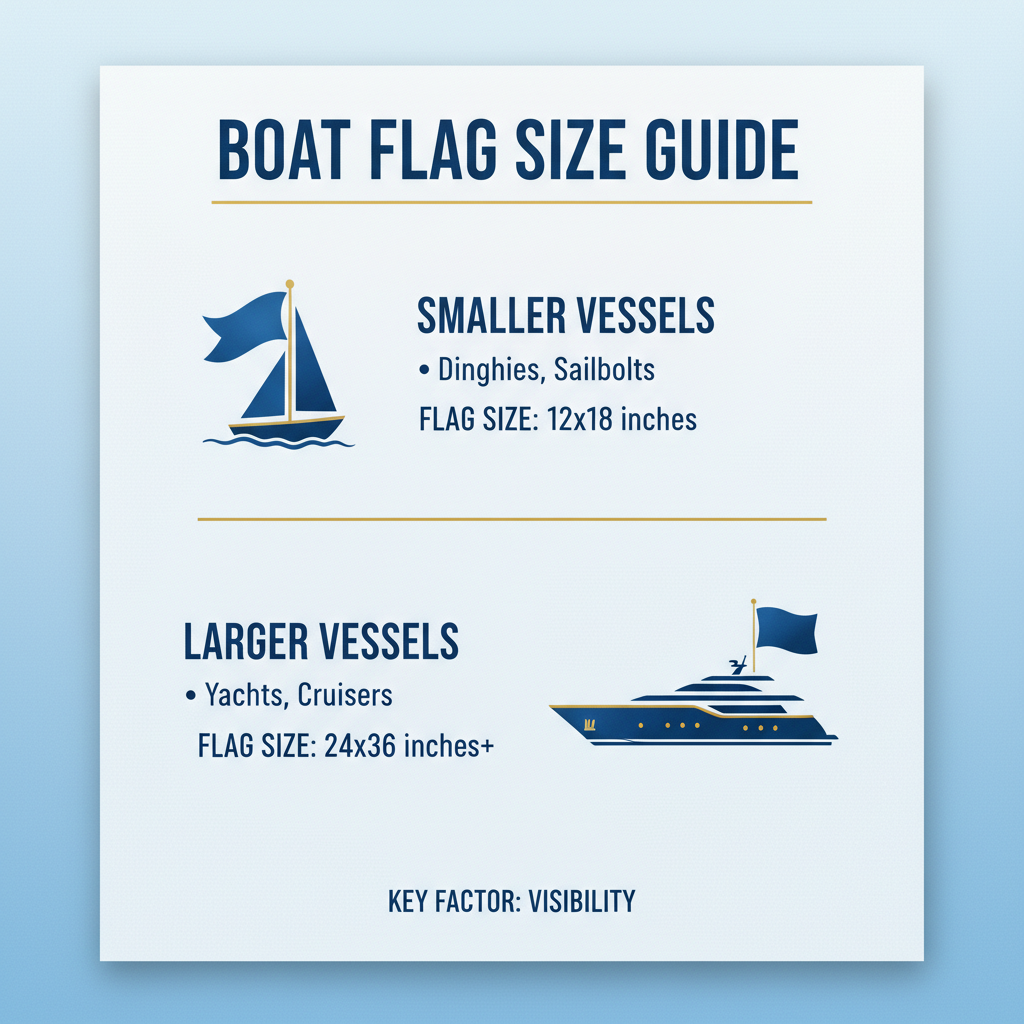
Flag size should be set by the distance from which the flag must be recognised. As a working rule for recreational craft, small boats such as dinghies and tenders take flags around 12 x 18 in, general motorboats and cruisers sit at 3 x 5 ft, and larger yachts use 24 x 36 in and above, with event or racing flags reaching 4 x 6 ft where they must read from shore.
- Keep the flag’s hoist proportionate to the staff or halyard it hangs from.
- Increase size for high-visibility positions, not for the sake of appearance.
- Step down a size where the flag will be permanently exposed to strong wind.
- Match the size of courtesy flags below the ensign to follow common practice.
Rigging: Staffs, Clips, Halyards, and Holders
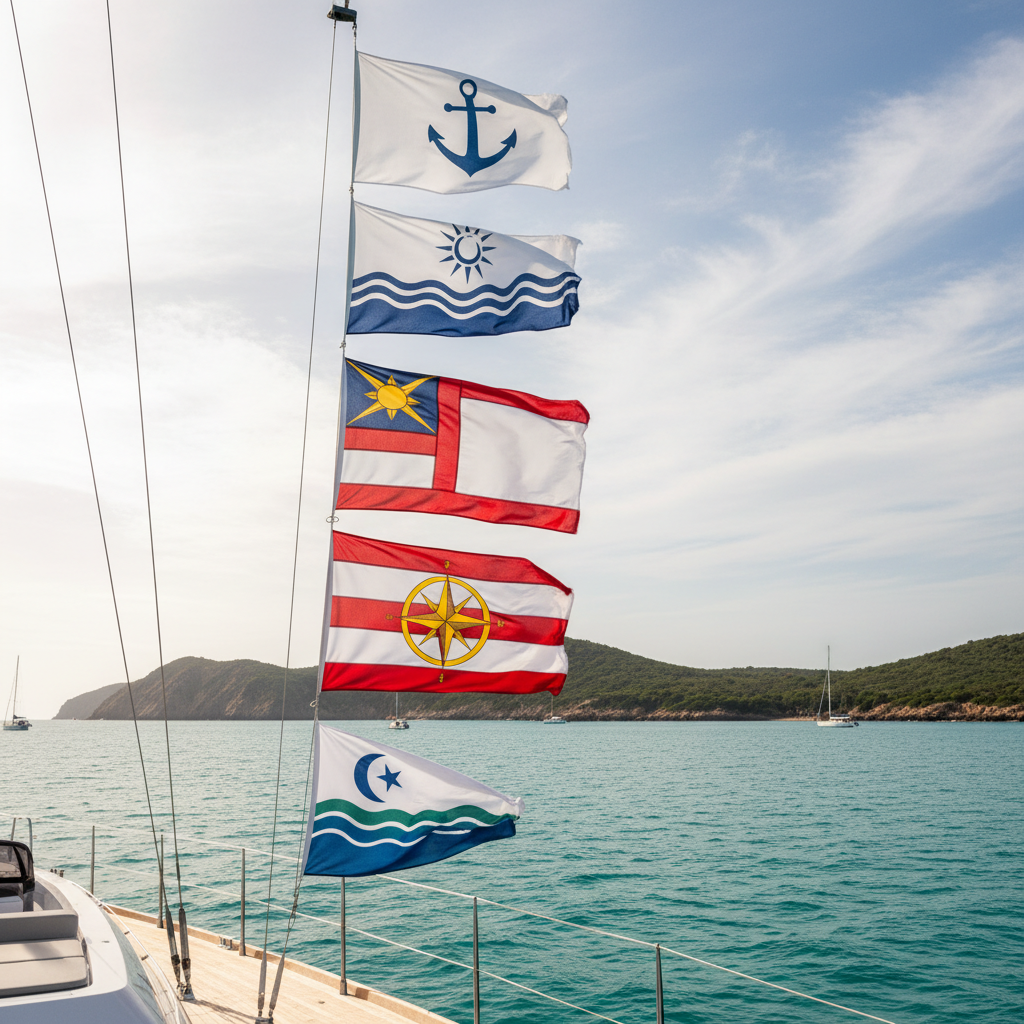
Rigging is what keeps the flag flying clean. A staff suits a fixed position at the stern or on a radar arch. A halyard with swivel clips lets the flag rotate free instead of wrapping around the hoist, and it is the practical choice for flags that are raised and lowered daily. A boat flag holder handles the intermediate case: a short or angled mount where the flag needs a clear sightline without a full pole.
Materials matter as much as geometry. Stainless fittings resist corrosion, and every bearing surface should be checked for binding. Complete the display with a weighted or braced base where the mount is freestanding. Our outdoor flag pole and flagpole accessories lines cover poles, holders, clips, and halyards so the flag and its rigging arrive as one specification.
Compliance Flags and Display Positions
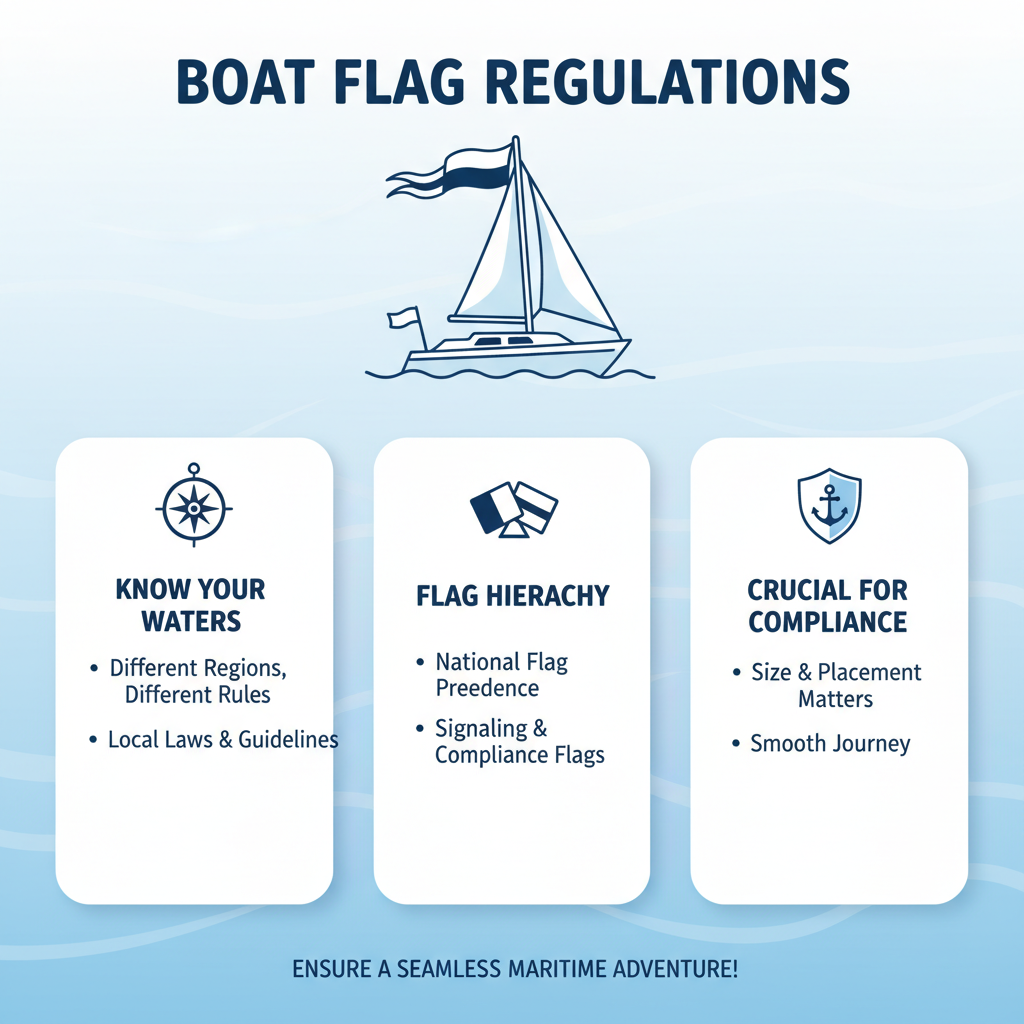
A complete marine flag set usually contains an ensign for the country of registration, one or more courtesy flags for the countries being visited, and a handful of signal flags from the International Code of Signals. The ‘A’ flag, for instance, signals diving operations in progress. Some jurisdictions also expect a yellow quarantine flag during customs or health clearance, and most require the ensign to be flown at the stern in daylight while underway.
Local rules vary, so confirm the requirements for each cruising ground before the season starts. What does not vary is proportion: a courtesy flag cut to the wrong ratio or flown upside down reads as a mistake.
Maintenance and Replacement Rhythm
Flag life is mostly a function of cleaning and storage. Rinse salt out with fresh water, use only mild detergent, and air-dry fully before packing. Avoid harsh chemicals, which weaken the weave. In the off-season, store flags rolled rather than folded in a cool, dry place out of sunlight, because tight creases become fracture lines.
Then set a replacement trigger and stick to it: a faded field or a frayed edge means the flag has already stopped doing its job. Keeping two sets in rotation, one flying and one clean and dry, is the simplest way to keep a vessel looking sharp all season.
Ordering Marine Boat Flags in Volume
If you are buying for a fleet, a club, or a reseller programme, standardise on one fabric and two or three sizes, and specify attachment hardware at the same time. That keeps replacement stock interchangeable and avoids a drawer full of incompatible fittings.
Send your flag specification to our team through the quote request on our contact page: list the flag type, finished size, fabric preference, print sides, and quantity for each line, and attach artwork for any custom design. We will confirm construction details, propose the fittings needed for your mounting positions, and include the flags in one production run under our OEM and ODM service.