Most tent enquiries are for one unit. This one was for four — and the number is what made it a different job.
The buyer was the organiser behind a lubricant brand’s Asia-Pacific motorsport activation. The four canopies were not going to different sites: they were going to the same event, standing within sight of each other, carrying the same artwork, and photographed from every angle by people standing in front of them.
That changes the brief. A single printed tent only has to match its proof. Four have to match each other.
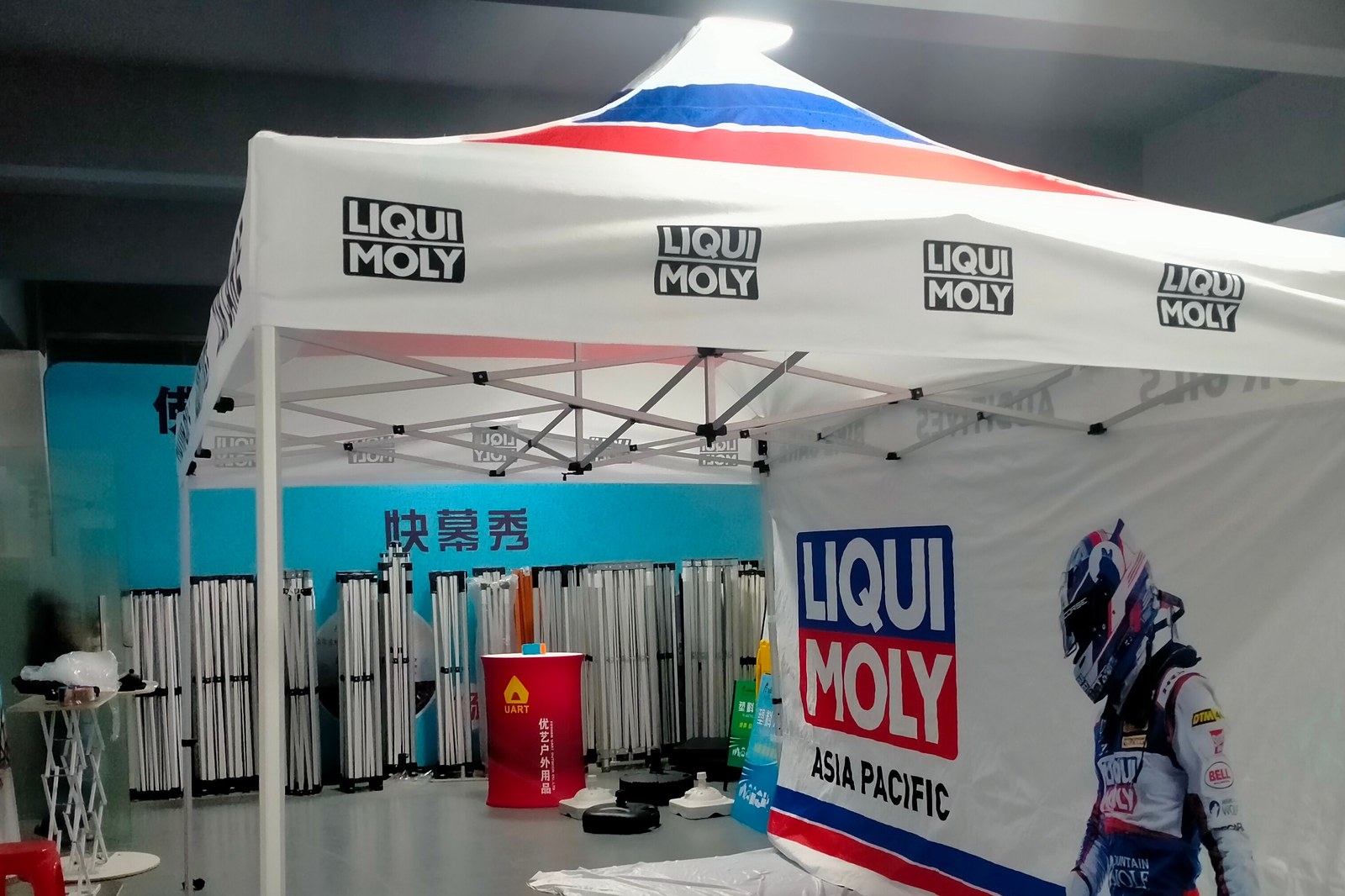
Project at a glance
| Item | Specification |
|---|---|
| Size | 3 × 4.5 m |
| Frame | 40-series hexagonal aluminium frame (diamond profile) |
| Fabric | 260 g/m² 600D × 600D PU-coated oxford, waterproof, US-standard flame retardant |
| High-concentration inks; canopy top printed single-sided | |
| Walls | One 600D wall, single-sided print; plus a 4.5 m full surround printed on both faces with a different design each side |
| Lining | Blackout layer behind the double-sided surround |
| Packing | Oxford carry bag per unit |
What the order had to do
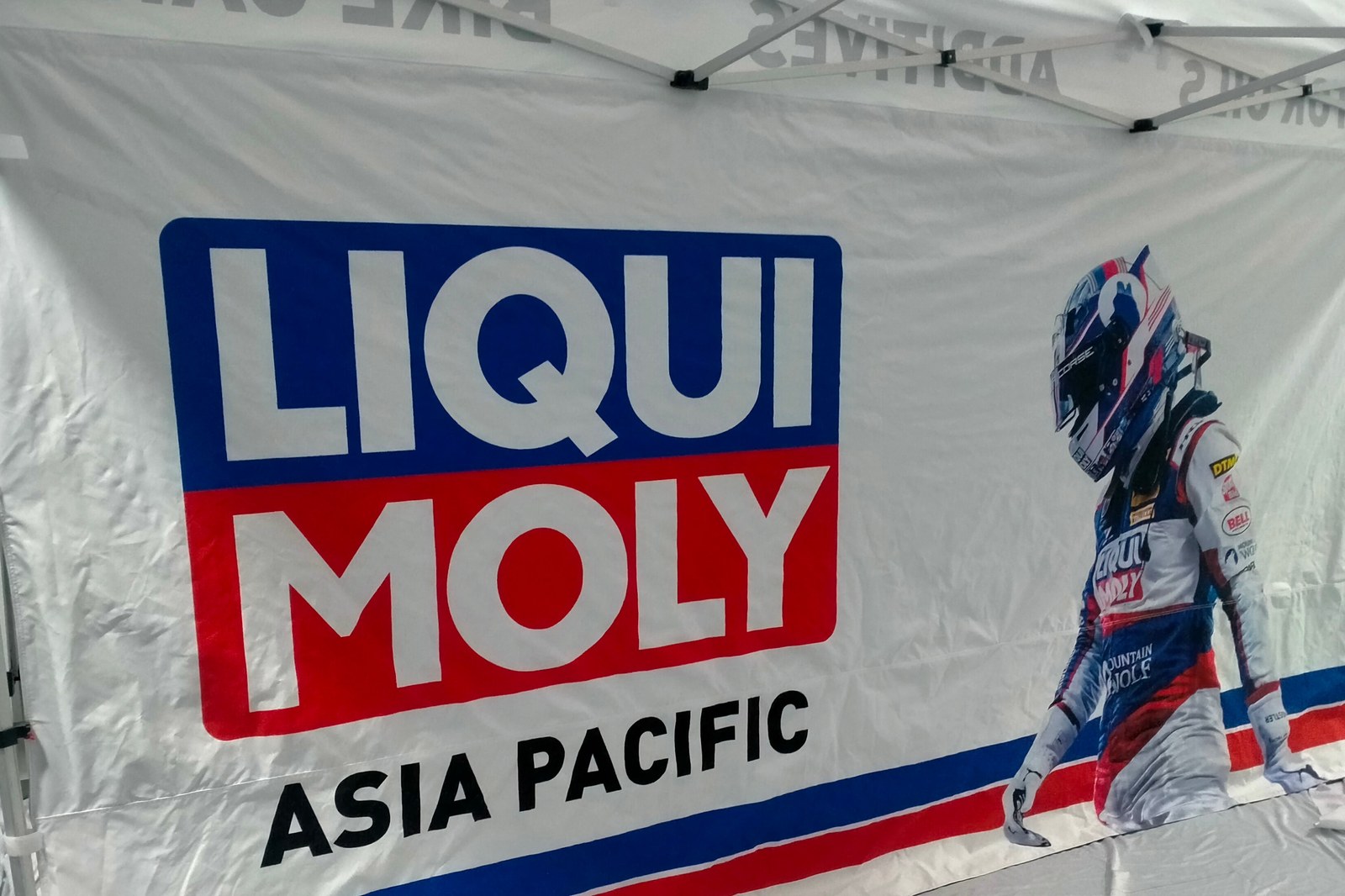
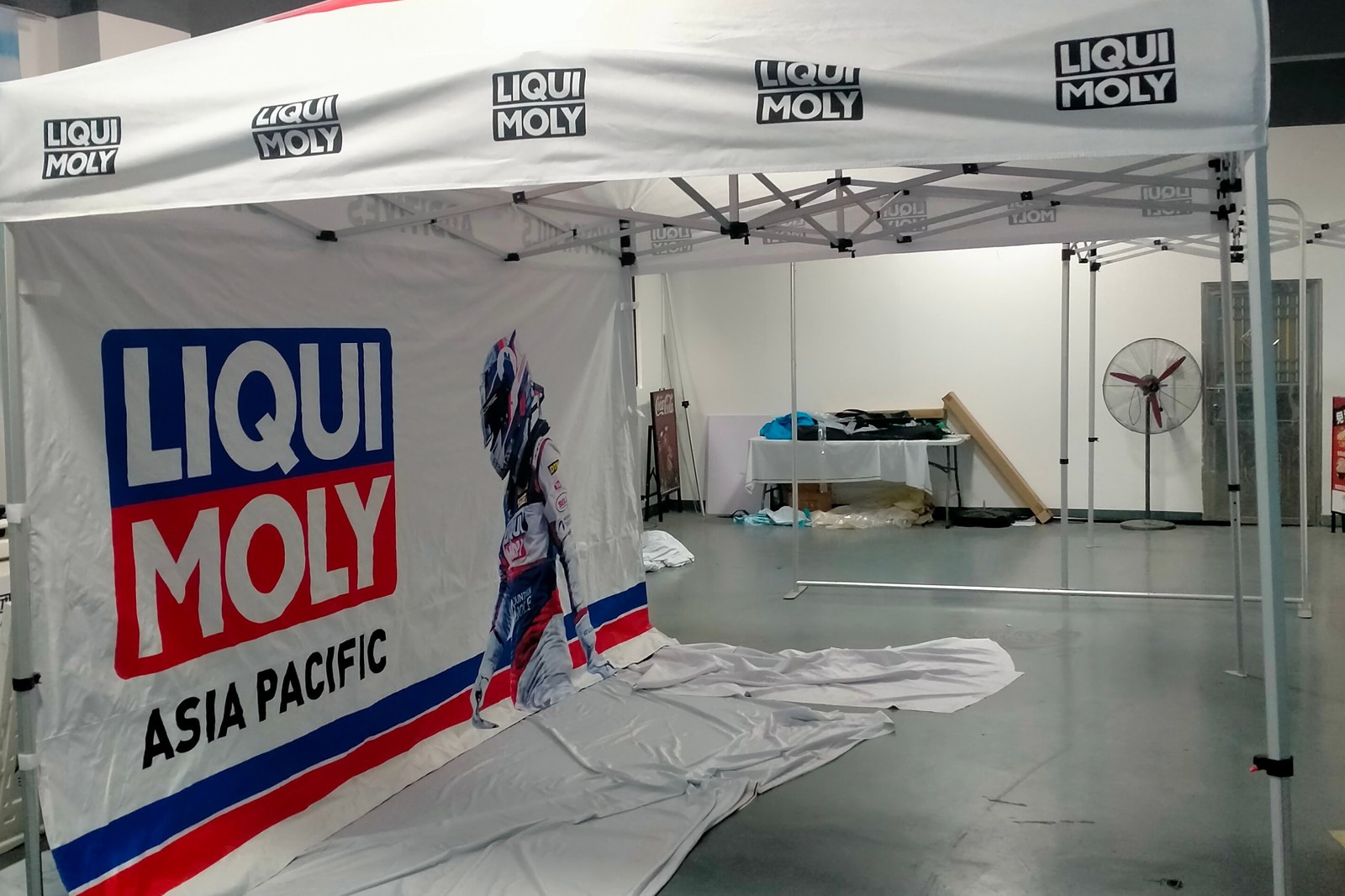
Each unit carries three printed surfaces: the canopy top, where the logo repeats around the valance; a single 600D wall printed on one face; and a 4.5 m surround printed on both faces, with a different design inside and out. The wall is the piece people stand in front of and photograph, so it has to read at two distances at once — the logo from across a paddock, the rider from two or three metres.
The fabric is US-standard flame retardant — increasingly a condition of entry for indoor venues and event permits. For the organiser, the risk is not “will a tent arrive”. It is that four tents from one purchase order arrive looking like four different prints: one warmer, one with the logo half a centimetre lower, one where the rider’s shoulder lands on a seam.
Four identical tents is not four times one tent
Print reproduction drifts. Ink batches differ slightly, panel nesting shifts, and a long run on fabric is not a colour-managed proof. Across four units the drift becomes visible, because the units stand side by side and visitors walk from one to the next.
Three things prevent it:
- One print run, not four. All four copies are nested and printed together, so they share a batch and a colour profile.
- One artwork file, panel by panel. The wall is split into panels at the frame’s seams before printing, not after. The seam positions are fixed by the frame, so the artwork has to be built around them.
- Labelled sets. Each unit’s panels are marked 1 to 4 and packed with its own frame. On site nobody has to work out which wall belongs to which canopy.
Printing a wall people stand in front of
Three decisions matter more than the file resolution.
Safe zones. The frame legs, the roof edge and the ground all cut into the visible area of a wall. Text or a logo placed near the bottom disappears behind people and tables; placed near the top it disappears under the valance. The brand block sits in the middle band, where a standing person actually looks.
Seams through the artwork. A wall panel is not one piece of fabric. Where two panels meet, a thin line of the image is lost. On this artwork the seam falls in the empty white field between the logo block and the rider, not across the rider’s helmet or the wordmark.
Two reading distances, one file. The logo is a shape read from 10–20 m; the rider is an image read from 2–3 m. The logo can be flat colour, the rider cannot — so the file mixes vector brand elements with a photographic image, and both are proofed on the same fabric rather than on paper.
Printing both faces of one wall
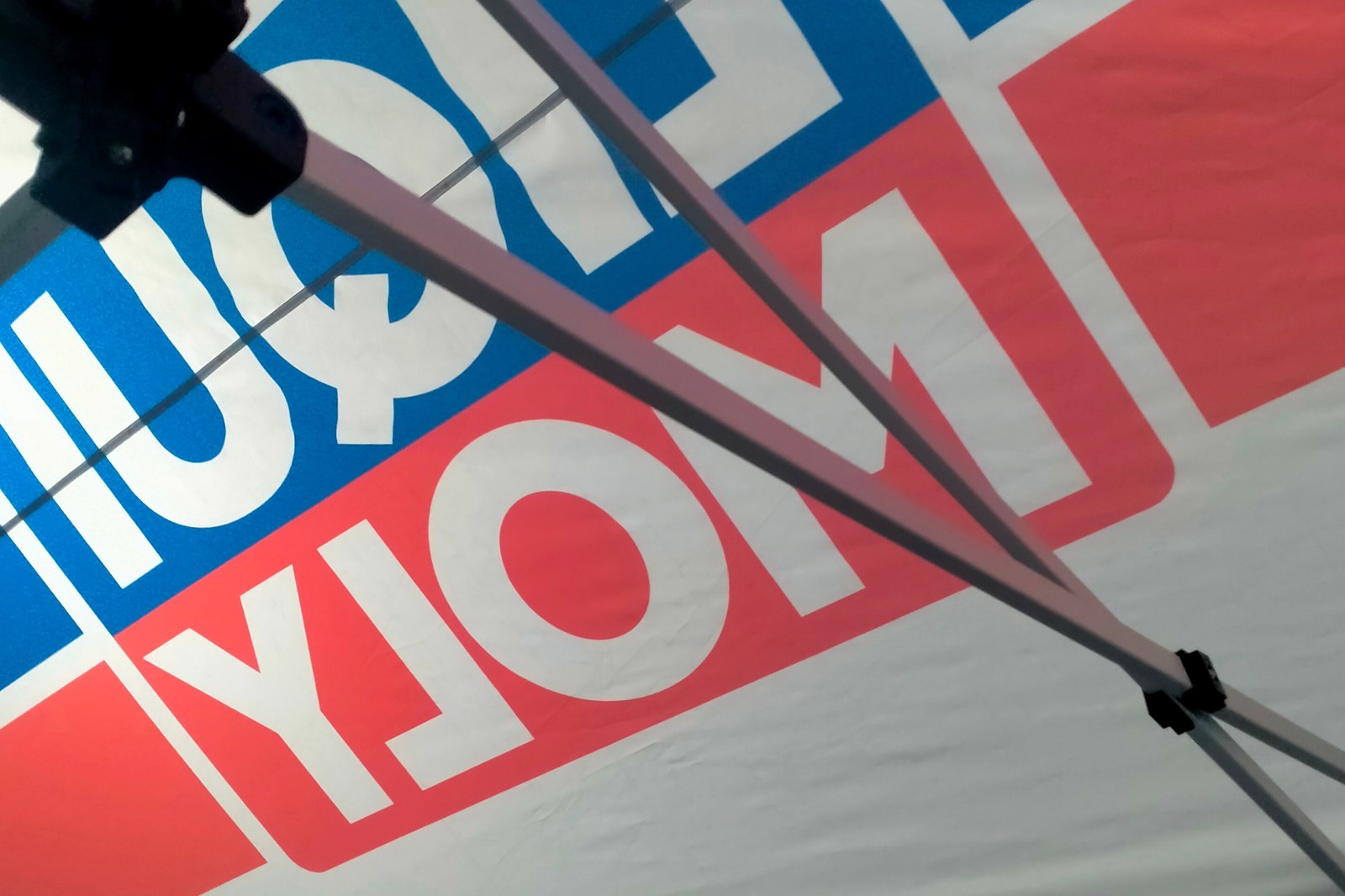
Double-sided printing is the part that looks simple and is not. The same fabric carries two different designs, so ink from the outside face can ghost through to the inside under strong light, and the two prints have to be registered well enough that the wall hangs flat instead of curling at the seams.
Three things make it work:
- A blackout layer. The surround is built with an opaque lining between the two printed faces, so neither design shows through when the sun is behind the tent.
- One panel plan. Both faces are split at the same seams, in the same order, so the lining and the two prints align on the frame.
- Separate artwork per face. The outside is the brand read from across a paddock; the inside is what people see while standing under the canopy, at arm’s length. They are not mirror images — they are two layouts, printed in two passes.
Frame, set-up and anchoring
The frame is a pop-up type: one piece that unfolds, with cross bracing in the roof and height-adjustable legs. Two people can raise a unit without tools, and the adjustable legs matter more than they sound — a paddock or a car park is rarely level, and four canopies standing in a row make any difference in height obvious.
Anchoring is the part organisers underestimate. On tarmac or concrete there is nothing to stake into, so the units rely on ballast at each leg base, and on the venue’s rules about what may be placed on the surface. Before the event, three questions to the venue settle it: what is the floor, what is allowed to hold the structure down, and what is the clear height where the tents will stand.
Packing four units
Four tents means four frames, four canopies, four walls and a set of accessories — and it all has to arrive in a way that can be unpacked by event staff at six in the morning.
Each unit packs into its own bag with its frame and panels; the accessory bag travels separately so stakes, ropes and weights are not loose against the printed fabric; and the units are labelled rather than left to be identified by opening them. A spare parts kit travels with the order, because a missing cross-brace 200 km from the warehouse is not a problem that can be solved on the day.
What to send for a quote on a multi-unit order
- Unit count — and whether they will stand together or apart. Standing together is a stricter brief.
- Footprint and wall layout — how many walls, which sides, and where the opening goes.
- Artwork — in whatever state it exists. What matters is knowing which elements are vector and which are photographic.
- Event date — the date it has to be on site, not the date of the event.
- Surface and wind exposure — grass, tarmac or hall floor; open field or sheltered.
- Whether the tents travel — a unit that moves between events needs a different bag and a different frame spec from one that is installed once.
Four units, one artwork, one run: that is the whole brief. The rest is bookkeeping.
Related reading
- Advertising Tent Buying Guide for 2026 Wholesale Buyers
- The History and Evolution of Canopy Tents
- Custom Table Covers for Trade Shows: A Buyer’s Guide
- Custom Inflatables for Events: Domes, Arches and Tents
- 16 SKUs at 50 Pieces Each: A US Brand’s Customer Gift Collection