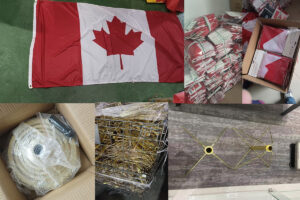
Most base failures are not manufacturing defects. They are selection errors: a base that was right for a sheltered forecourt gets specified for an exposed coastal car park, or a pole is matched to a base by height when it should be matched by sail area and wind speed. This article sets out a repeatable way to think about how to choose the right flag base for wind, using the pole and base specifications we build and the wind classes we work to.
How to Choose the Right Flag Base for Wind: Start With the Load
The load on a flag base has three inputs, and only one of them is the pole:
- Flag area. A flag is a sail. Doubling flag area roughly doubles the overturning moment on the base at the same wind speed, whatever the pole is made of.
- Wind speed at the site. Not the regional average — the gust value in the worst month, on the worst ground. A plaza between two buildings behaves nothing like the field next to it.
- Pole stiffness and lever arm. A taller, more flexible pole puts more moment into the anchor point for the same flag.
The base is the last item in the chain and the first item that fails when the three inputs above were never stated. Write them down before you compare bases.
Base Types and Where Each One Fails
| Base type | Anchoring principle | Works well on | Where it fails |
|---|---|---|---|
| Plastic water-fill base | Dead weight, filled on site | Indoor floors, malls, street promotions, low wind | Empty bases on site; exposed sites where the fill can freeze or be drained |
| Iron plate base | Heavy dead weight, low centre of gravity | Open plazas, outdoor markets, moderate to high wind | Paved areas with weight limits; handling cost |
| X-shaped / cross base with water bag | Spread footprint plus added weight | Temporary events, mobile promotions, moderate wind | Very strong wind unless it is combined with ballast and stakes |
| Ground spike base | Drives into the substrate | Soft ground: sand, grass, soil, at high wind | Hard surfaces, buried services, shallow soil over rock |
| Ground sleeve plus concrete | Engineered foundation | Permanent in-ground installations | Where digging is not permitted or services cannot be located |
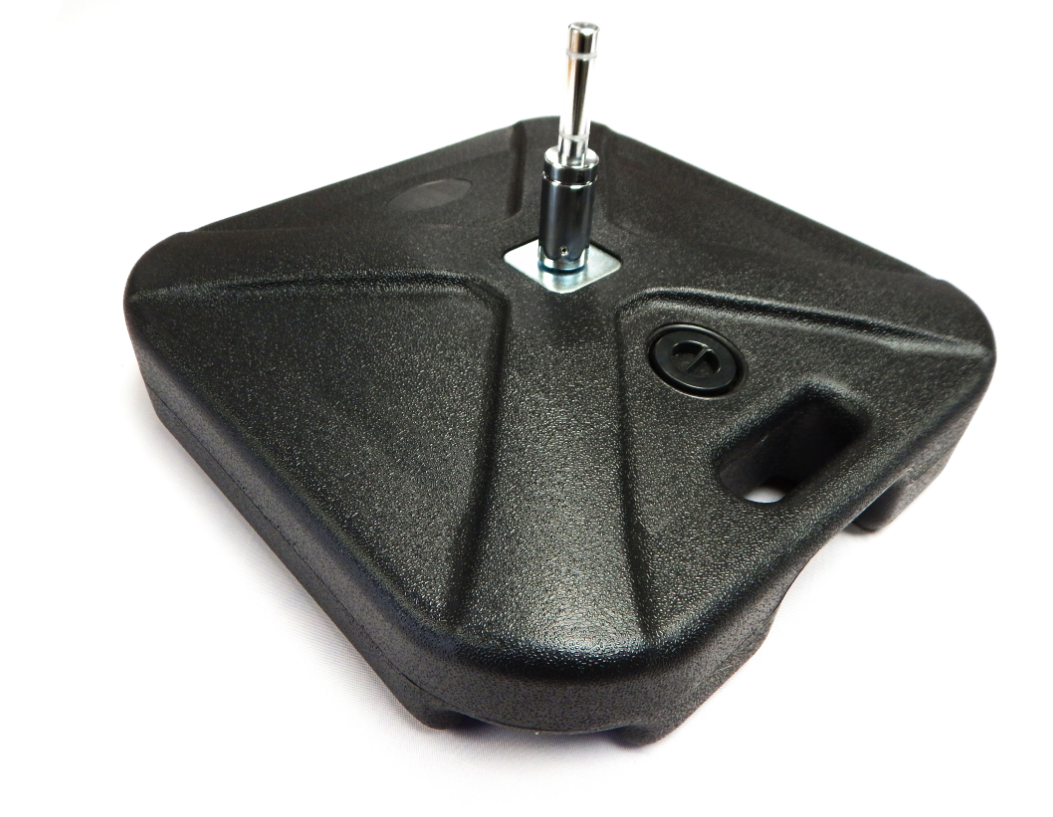
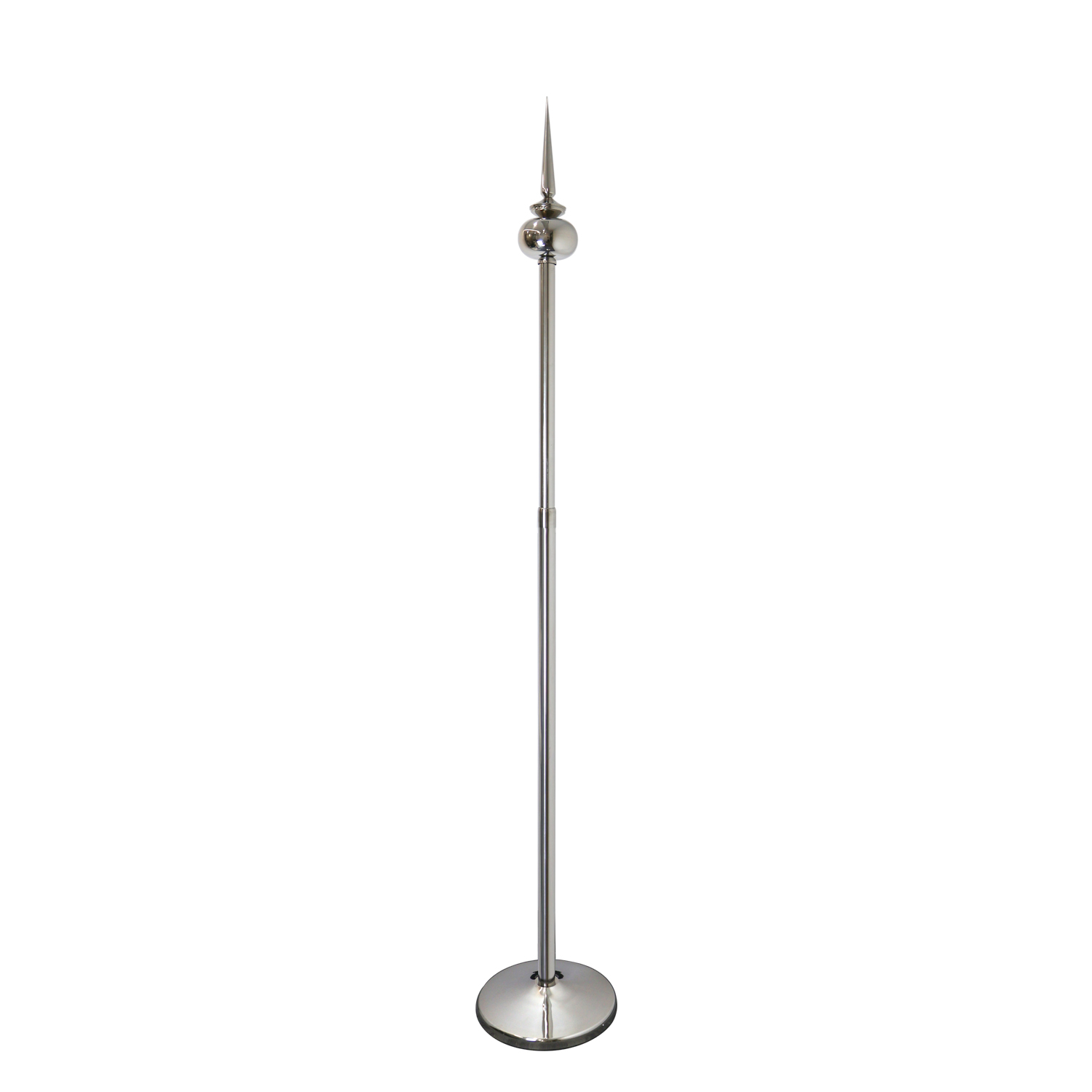
| One-piece die-cast floor base (36/45/48 cm) | Integrally formed weighted disc | Interior lobbies, showrooms, receptions | Outdoor wind exposure beyond its rated class |
Two of these are frequently mixed up in tenders. A cross base with a water bag and a one-piece die-cast disc are both “weighted bases”, but the disc concentrates mass low and central, while the cross base spreads the moment over a wider footprint. On a hard, flat floor the cross base usually wins; on a carpeted lobby the disc is cleaner and more stable under foot traffic.
Pole Stiffness: Wall Thickness and Section Count
Base selection cannot be separated from pole selection, because a flexible pole converts wind into movement and movement into fatigue at the joint. In our aluminium pole ranges, wall thickness is built at three levels, and each level maps to a wind class:
- 0.8 mm — indoor and sheltered use. Suitable for exhibitions, malls and street promotions in low wind.
- 1.0 mm — moderate wind. Open plazas, pedestrian streets and outdoor markets.
- 1.5 mm — strong wind. Coastal locations, parks and outdoor sports events; also the specification for year-round outdoor installations.
Fibreglass poles behave differently and are worth specifying separately: they flex further before breaking, which is why they are the usual answer in sustained high wind such as beaches, harbours and high-altitude sites, where an aluminium pole would take a permanent set.
Matching Base Weight to Pole and Flag Area
There is no single correct ratio, but there is a defensible way to specify one: state the flag dimensions, the pole length, and the wind class, then ask the supplier to confirm the base mass that holds that combination. Where you are working from physical products rather than a calculation, use the weights as a sanity check against the application. Our floor-base poles illustrate how widely that mass varies for the same nominal purpose:
| Pole configuration | Base diameter | Pole weight | Total weight | Wall thickness |
|---|---|---|---|---|
| Economy floor pole, spliced or telescoping, ~2.4 m | 36 cm, one-piece | ~2.4 kg | ~8 kg | 0.8 mm |
| Mid-range floor pole, ~2.4 m | 45 cm, one-piece | ~4.2 kg | ~9 kg | 1.0 mm class |
| Premium floor pole, telescoping, ~2.4 m or custom | 48 cm, integrally formed | ~4.7 kg | ~15 kg | 1.2 mm, top ornament 2 mm |
Read the pattern rather than the individual figures: as wall thickness rises, mass is added both in the shaft and in the base, and the base diameter grows to keep the footprint proportionate. A light pole on a heavy base is a stable display. A heavy pole on a light base is a warranty claim.
Construction Details That Decide Service Life
Once the class is right, the next question is how the base is actually made, because this is where nominally identical bases diverge:
- Welding method. On welded cross and floor bases, spot welding is the common structural weak point. Full-seam welding raises load-bearing capacity and produces a cleaner, seamless joint. Ask which one you are being quoted.
- Base forming. A one-piece, integrally formed base avoids the joint that cracked on the previous version. Die-cast counterweights made from virgin plastic are odourless and shock-resistant, which matters for indoor and hospitality use.
- Finish. Chromium plating followed by fine electroplating produces the mirror finish used on premium reception poles; multi-layer electroplating is what keeps that finish consistent and resistant to oxidation and wear. Uneven gold colour is a plating process problem, not a design problem.
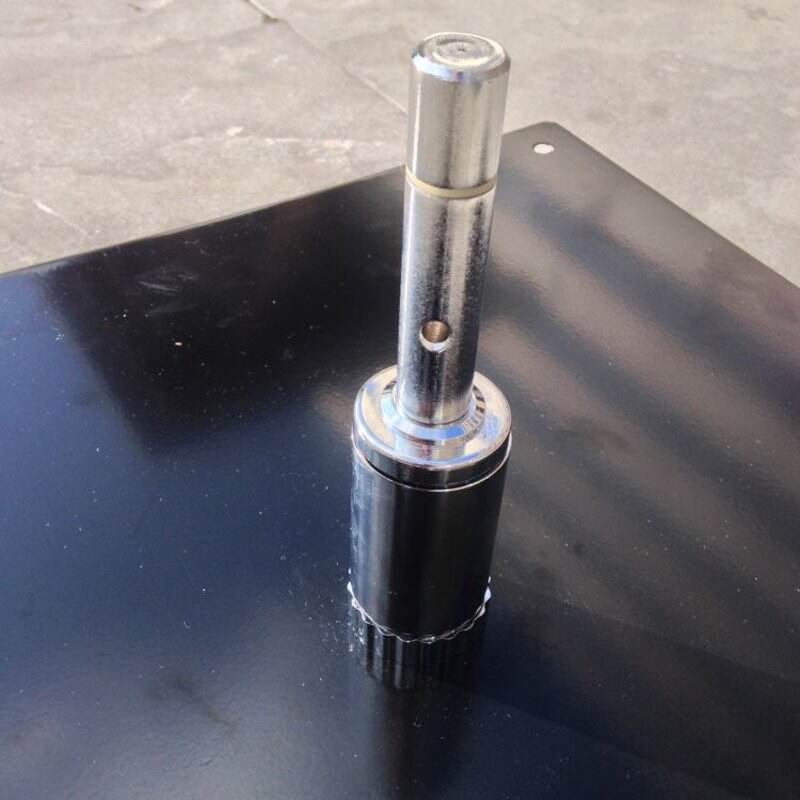
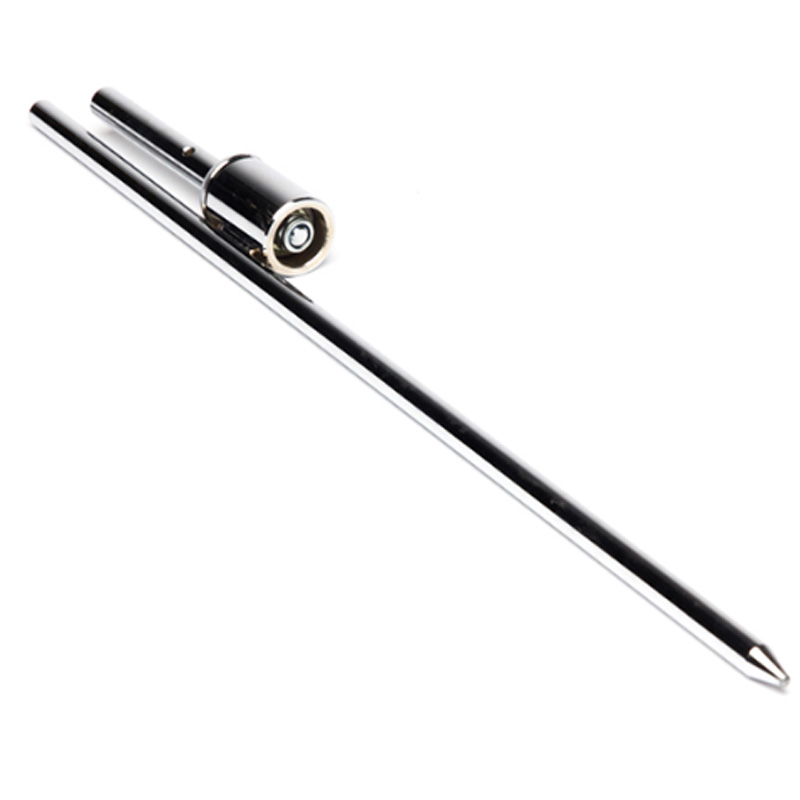
- Threaded stem and insert. The base-to-pole interface takes the full bending moment. Confirm the stem thread, the depth of engagement, and that the insert is a replaceable part rather than welded into a disposable assembly.
Selection Matrix by Application
| Wind condition | Pole to specify | Base to specify |
|---|---|---|
| Indoor or low wind | 0.8 mm aluminium | Plastic water-fill base or cross base |
| Moderate wind | 1.0 mm aluminium | Plastic water-fill base or iron plate base |
| Strong wind | 1.5 mm aluminium or fibreglass | Iron plate base, or cross base with water bag and ballast |
| Extreme wind | Fibreglass | Ground spike base or iron plate base |
| Permanent outdoor, any exposure | Multi-section aluminium on a concrete foundation | Ground sleeve set in concrete, gravel drainage below |
If the site is genuinely high wind and the base cannot be an in-ground foundation, the honest recommendation is a flexible pole with a spike or iron-plate base rather than a stiff pole on a light disc. Stability in strong wind comes from giving the movement somewhere to go, not from resisting it with mass alone.
Specification Questions to Send to Your Supplier
- What is the maximum wind speed the base is rated for, and at what flag area?
- Is the base mass quoted with or without the fill or ballast?
- Is the pole wall thickness 0.8 mm, 1.0 mm or 1.5 mm, and is fibreglass an option for this application?
- How is the base joined — spot welded or full-seam welded? Is it one-piece or assembled?
- What is the surface treatment, and how many plating layers are applied?
- What is the base diameter and total assembly weight as shipped?
- For in-ground installations: what sleeve length, hole diameter and concrete volume are specified?
Bases and poles are matched items rather than independent purchases. For freestanding advertising flags the selection logic is identical but the products differ — see our flag banner range for spike, water and iron-plate bases, outdoor flag pole for permanent in-ground installations, and flagpole accessories for replacement stems, sleeves and brackets.
Next Step: Get a Quote
Send us the flag size, the pole height, the mounting surface and the worst wind speed the site sees. Get a Quote and ask specifically for the rated wind speed and base mass for that combination — those two figures are what you will be held to if the display fails.