Telescoping Flagpole Wholesale: What Event Buyers Specify
Event organisers buy flagpoles the way they buy staging: in sets, for a defined season, and with the expectation that they will still work at the last show on the calendar. Telescoping flagpole wholesale orders therefore succeed or fail on a short list of specification decisions — height, material, base, locking system, accessories, and packing.
This guide is written for distributors, rental companies, and brand marketing teams placing volume orders with Chinese suppliers. It covers the models worth stocking for outdoor events, the materials that survive real weather, how bases change what the pole can do, and the OEM options that turn a generic pole into your own product line.
Heights, Sections, and Locking Collars
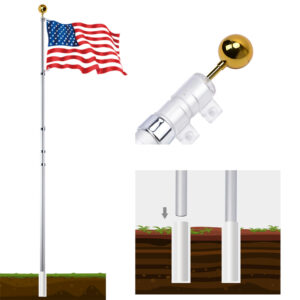
A telescoping pole collapses into itself for transport and extends section by section when raised. The mechanism is what makes it attractive for events: no digging, no fixed installation, and no dedicated transport vehicle.
Height options commonly stocked for events run from compact 12 ft models through 16 ft, 20 ft, 25 ft and 30 ft units, with 15 to 25 ft covering the majority of festival, parade, and sports applications. Each additional section increases reach and also increases the load on the locking collars, so the locking system deserves close attention. Specify collars that engage positively and cannot be released by the pole flexing in a gust, and test the collapse action on the sample unit rather than on the production container.
| Height class | Typical use | Handling | Base pairing |
|---|---|---|---|
| 12 to 16 ft | Storefronts, indoor-exit promotion, small booths | One-person, hand carried | Tripod or plastic base |
| 20 ft | Event entrances, sponsor markers | One to two people | Ground spike or weighted base |
| 25 ft | Festival perimeters, sports fields | Two people | Weighted base or concrete mount |
| 30 ft | Parades, high-visibility brand positions | Two people, assisted | Heavy-duty base, anchor bolts |
Material Selection for Event Conditions
Three materials dominate the category. Aluminum is light, resists corrosion, and is the practical default for poles that move from venue to venue. Fiberglass resists corrosion and UV and is a good fit for coastal sites, though it is less rigid in its thinner sections. Stainless steel, typically in 304 or 316 grade for this application, offers the best strength and longevity but adds weight and handling effort.
| Material | Weight | Corrosion and UV | Choose it when |
|---|---|---|---|
| Aluminum | Light | Good | Poles travel between sites and crews are small |
| Fiberglass | Light | Excellent | Coastal, humid, or high-UV locations |
| Stainless steel 304/316 | Heavy | Excellent | Permanent-looking installs and the longest service life |
Wall thickness is the quiet specification. For round tapered poles it commonly falls in the 2.5 mm to 5 mm band, with the thicker end of that range reserved for the tallest or most exposed installations. Ask for the wall thickness in writing rather than a nominal “heavy duty” label.
Bases and Ground Hardware for Different Surfaces
The base is what converts a pole from a display into a structure. A ground spike is fast to set in soft turf and needs no extra weight. A weighted base carries its own ballast and works on pavement, indoor floors, and event decks. Tripod bases give the fastest setup where footprint matters more than height, and concrete or anchor-bolt mounting is the answer where a pole will stay in place for a full season.
- Soft ground: drive-in spike, checked for depth and firmness before the flag goes up.
- Hard or indoor surfaces: weighted base sized to the pole height and flag area.
- Long-duration installs: concrete or base plate with anchor bolts.
- High-exposure sites: heavier base plus a shorter flag on the same pole.
Two points matter for wholesale planning: bases are usually the heaviest item in the carton, and they must be ordered in the same ratio as the poles. An order of 200 poles and 150 spikes is a problem that only shows up on site.
Spec Sheet and Bulk Packaging Checks
For a wholesale order, the specification sheet is the product. It should state the model height, collapsed length, number of sections, material and wall thickness, tube diameter, finish, base type, accessory list, and net and gross weight per carton.
Packaging is where bulk orders quietly gain or lose money. Confirm the carton dimensions and the number of pole sets per carton, ask for a carry bag with each set, and require that bases ship in their own cartons so the pole tubes are not carrying 20 kg of ballast in transit. Accessories should be bagged and labelled per set, not loose in the box.
OEM Branding and Accessory Bundles
Telescoping poles are a natural private-label product. The pole itself is rarely branded, so the identity sits in the packaging and printed collateral: the carry bag, the carton print, the instruction sheet, and any inserts you supply.
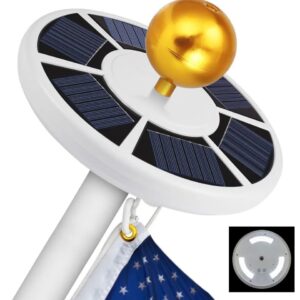
Accessory bundling is the other lever. A complete set — pole, base, finial ball, halyard or hang rod, base plate, and anchor bolts, plus a carry bag — sells as a kit and reduces customer support queries, because nothing has to be sourced separately. Our advertising display products and OEM and ODM lines cover kit configuration and private-label packaging, and the flagpole accessories range supplies halyards, finials, and mounting hardware to finish the set.
Field Kit: What to Send With Each Pole
- Pole sections, checked for joint fit and collar action before dispatch.
- Base or spike matched to the intended surface.
- Halyard or hang rod, plus a spare clip.
- Base plate and anchor bolts for fixed installations.
- Printed setup and maintenance sheet with the pole height and recommended flag size.
- Carry bag rated for repeated transport.
On the rental and events side, this kit list also becomes the check-off sheet at load-out. A missing spike costs a site visit; a spare clip in the bag costs nothing.
Installation and Maintenance in Service
Setup discipline prevents most failures. Choose a clear, level position, rake or seat the base properly, raise the pole steadily, and lock each collar fully before fitting the flag. Weight the flag choice to the pole: a heavier flag on a light pole will bend sections and loosen collars over a season.
Between events, wipe and dry the poles, inspect collars and joints for wear, and check the base hardware for deformation. Lubricate moving parts sparingly and store the poles horizontally, supported along their length, so they do not take a permanent set. Our outdoor flag pole range follows the same multi-section construction logic for customers who need both travelling and semi-permanent display.
Placing a Wholesale Order
Send one message with the whole requirement: model heights, material, base types and their ratio to poles, accessory kit contents, branding on bag and carton, market, and the quantities you plan for the first order and the following twelve months.
Our team will confirm the specifications, flag any mismatch between pole height and base, propose a kit structure, and return a quotation and sampling plan through our contact page. If you are supplying rental fleets or dealer networks, say so — that changes the recommended spare-parts ratio and packing format.