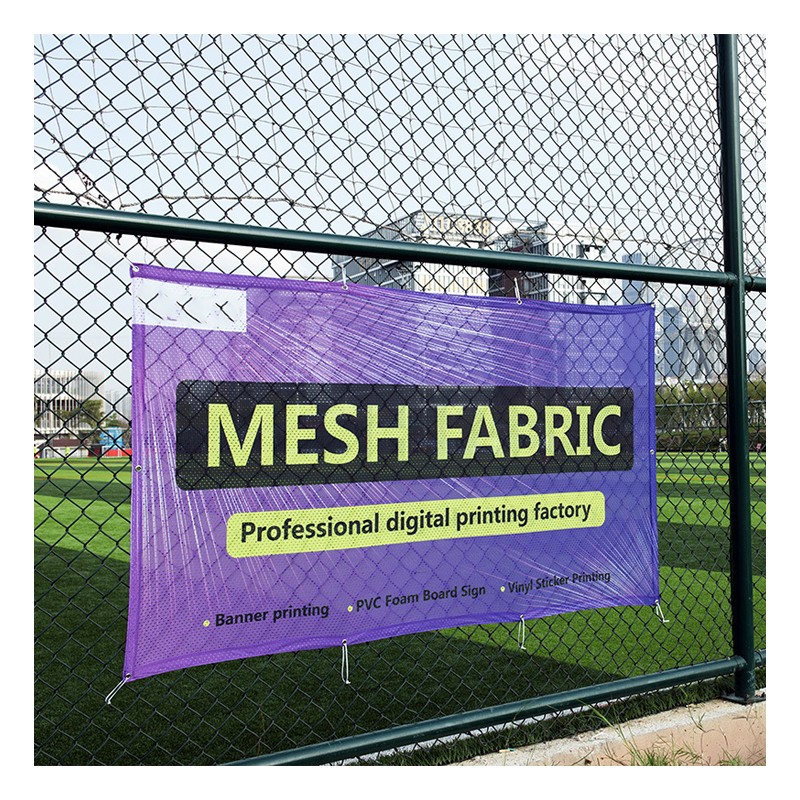
A mesh banner is the practical answer for anywhere a solid banner would act like a sail: chain-link fences, site hoardings, sports ground perimeters and event barriers. The fabric is woven with a regular pattern of small holes, so wind passes through instead of loading the banner, and the print stays flat on the fence rather than ballooning between the fixings.
At a glance
- Material: 120 g/m² mesh fabric (woven, perforated)
- Printing: single-sided, full colour to your artwork
- Finishing: hemmed on all four edges, brass grommets at standard spacing
- Sizes: made to order — any width × height, no fixed size list
- Minimum order: none — one piece is possible
Why mesh rather than solid banner fabric
Solid PVC or polyester makes a good indoor banner and a poor outdoor one. Once it is laced to a fence, wind has nowhere to go: the banner stretches, the eyelets pull, and in a strong gust the fabric tears from the corner inward.
Mesh solves that with geometry rather than with heavier material. The open area lets air through, which reduces the load on the hem and the grommets, and it lets the banner sit tight against a chain-link fence instead of drumming against it. The same property makes mesh the usual choice for anything that stays up for weeks — construction hoardings, sports club fencing, event perimeters.
The trade-off is resolution. Fine type and small logos lose definition against the weave, so artwork for mesh should use larger type and simpler shapes than the same design on a solid banner.
Finishing: hems and brass grommets
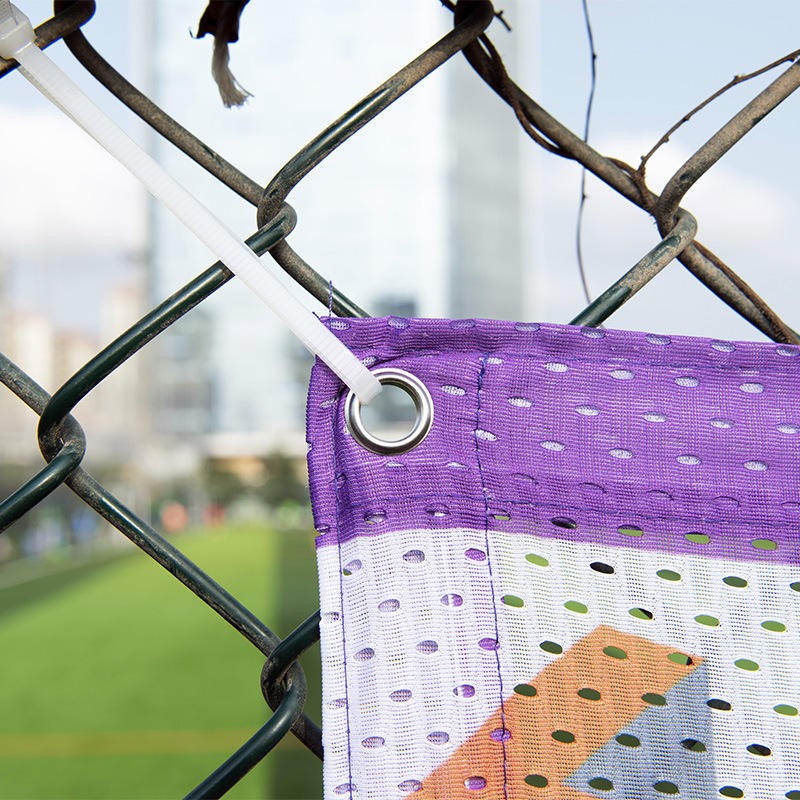
Every banner is hemmed on all four edges and fitted with brass grommets at standard spacing. The hem carries the tension; the grommets are where the load enters the fabric, which is why they are brass rather than a coated eyelet — they do not rust through a season outdoors.
For fence mounting, the usual fixing is a cable tie through each grommet and around the mesh of the fence. The close-up below shows the detail: grommet, hem, and the woven mesh where the tie passes through.
Sizes and how to specify them
Mesh banners are made to order, so there is no size list to choose from. Three numbers settle a quotation:
- Width × height in the units you work in — or the fence bay it has to cover.
- Grommet spacing, if the fence posts dictate it; otherwise standard spacing is used.
- Orientation and viewing distance, which decide how large the type has to be before the mesh eats into it.
Because there is no minimum order, a single replacement banner for one damaged bay costs the same per square metre as a full set — useful when a club or a site needs to replace one panel rather than reprint everything.
Where mesh banners are used
Chain-link fencing around sports pitches and training grounds; construction hoardings and site boundaries; event perimeters, start and finish lines; sponsor boards where the banner has to stay up for a full season. In each case the reason is the same: the banner has to survive wind without a rigid frame behind it.
Request a quotation or see our completed projects.
Project example
A Spanish race organiser’s repeat order included 110 mesh banners at 2 × 0.8 m — 40 black and 70 yellow — printed single-sided on 120 g mesh, hemmed and grommeted, for two race courses in Catalonia.
Frequently asked questions
Can mesh banners be made in any size?
Yes. They are made to order to any width and height; there is no fixed size list to choose from.
Is the print single or double sided?
Single-sided, full colour to your artwork.
How are the edges finished?
Hemmed on all four edges, with brass grommets at standard spacing.
Is there a minimum order?
None — one piece is possible, which also makes single-panel replacements practical.