Commercial flagpole installation is rarely a product purchase. It is a specification exercise, and the gap between a good and a poor outcome is decided before the PO — in the numbers the buyer did or did not put in writing. This article sets out the parameters that belong in a commercial flagpole installation brief, in the order they should be fixed.
Commercial Flagpole Installation Starts With the Brief
Six parameters drive everything else, and every one of them should be stated rather than assumed:
- Height, and the building or streetscape it has to relate to.
- Wind load rating for the site — not the city average.
- Shaft material, alloy and wall thickness.
- Halyard type: internal or external.
- Foundation or mounting detail.
- Lighting, and whether the flag is displayed after sunset.
Where any of the six is missing, the supplier will fill the gap with a default, and that default becomes the pole you own for the next twenty years.
Wind Load and Height: The Two Numbers That Drive Everything
Every flagpole has a maximum wind speed it can be rated to, and commercial installations are typically engineered to the wind zone of the specific site rather than a national default. Industry practice in North America references organisations such as NAAMM, which categorises poles by wind-speed exposure categories (A through D). Coastal and open-terrain sites sit at the demanding end; sheltered urban sites at the other. Inadequate wind protection is the standard cause of flagpole damage.
| Building type | Typical pole height | Height logic |
|---|---|---|
| Low-rise commercial, up to 4 storeys | 20–30 ft | Roughly 1/4 to 1/3 of building height for visual proportion |
| Mid-rise, 5–12 storeys | 30–50 ft | Same proportion rule, applied to the street-facing elevation |
| High-rise towers | 50–80 ft, or rooftop-mounted | Proportion plus rooftop structural review |
| Corporate campus / multi-flag array | 25–40 ft, often 3–5 poles | Symmetrical array at the entrance for national, corporate and regional flags |
Two consequences follow. Height and wind rating must be specified together, because a taller pole on the same foundation is a different structural problem. And if the pole goes on a roof or facade rather than in the ground, the load transfers into the building structure — a structural review before the pole type is fixed, not after.
Shaft Specification: Alloy, Wall Thickness and Finish
Most commercial poles are produced from seamless extruded aluminium in 6063-T6, which gives a workable balance of tensile strength and ductility: the shaft flexes under wind load without taking a permanent set. For heavy-duty work the differentiator is wall thickness and diameter, not the alloy alone. Residential poles may be built on a 0.125 in wall; commercial heavy-duty shafts start at 0.188 in and run up to 0.500 in on the largest poles. Wall thickness also affects vibration behaviour: a shaft whose natural frequency aligns with wind-induced vibration can enter the galloping motion that leads to structural failure, so mass and diameter are chosen partly to avoid that condition.
Finish is specified by environment. Anodising and powder coating are the two mainstream options, both available in a wide colour range — anodised clear, bronze, black and champagne, or powder coat to a stated colour reference. Coastal and industrial sites need the heavier anodised finishes, because salt spray and airborne pollutants pit lighter treatments.
Halyard and Hardware: Internal or External
- Internal halyard — the rope or wire runs inside the shaft. Better appearance, resistance to vandalism, and no rope slapping the pole in wind. This is the usual specification for corporate, government and hotel installations.
- Stainless steel cable halyard — used on tall shafts where rope stretch is a problem; the flag flies predictably in turbulent wind between buildings.
- Counterweight and sling assembly — the detail that stops metal striking metal inside the shaft on a windy night. On hospitality projects, specifying an internal counterweight or beaded sling is what keeps a 40 ft pole from becoming a noise source over guest rooms.
- Winch or manual cleat — a precision winch makes half-mast and multi-flag protocol practical for facilities staff without a climbing routine.
- Anti-vandal lock — relevant wherever the display is accessible at street level.
On large flags in high wind, oversized wall thickness, heavier rope and pulley systems, and anti-wrap mechanisms keep the display readable during an event rather than furled around the shaft.
Foundation and Ground Sleeve Detail
For in-ground commercial installation, the foundation is an engineered component, not a hole. Three entries belong in the specification:
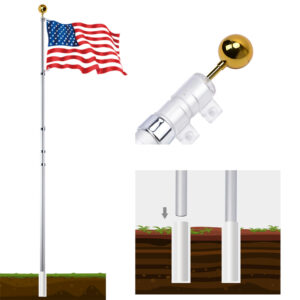
- Ground sleeve size — matched to the pole’s base section, and set so the top is flush with finished grade.
- Hole diameter and depth — as a multiplier of pole end diameter, with a drainage layer of crushed stone beneath the sleeve.
- Concrete volume and curing — poured around the sleeve, never into it, finished slightly below grade to allow topsoil or paving to close over the collar.
The sleeve lets the pole be lifted out for service, transport or storm preparation. It also creates the item most often ignored on commercial sites: the flash collar at grade, which is the path water uses into the foundation. Check and re-seal it — that detail decides whether the pole reaches its service life or corrodes from the base up.
Lighting, Power and Protocol Requirements
In the United States, flag code practice requires illumination when a flag is displayed after sunset. That requirement propagates into the electrical scope and should be settled while the site is still being planned:
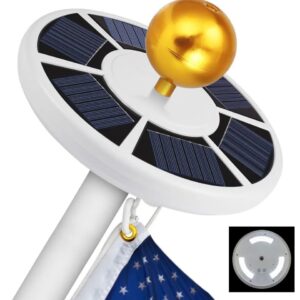
- Illuminated shafts and LED pole lighting are the mainstream route; solar-integrated heads are the no-trench alternative where power cannot reach the anchor point.
- Motorised raising systems with programmable timers and wind-speed cutoffs reduce labour and protect flag and pole, and can be tied to weather alerts so the flag lowers automatically in a gust.
- Half-mast capability is a protocol requirement, not an option, on government, institutional and embassy work.
Mounting for Facades and Rooftops
Not every commercial installation is in the ground. Wall-mounted brackets are the standard answer for hotel facades displaying guest nationalities, and modular or telescoping pole systems are widely specified where rooftop access is limited or local height rules apply, because they can be assembled on site without heavy lifting equipment. Both cases move the load into the building, so both require the structural review referenced above. On a rooftop install, agree penetrations, waterproofing and the wind-uplift case with the contractor, not the pole supplier alone.
Documentation and Submittals to Request
| Item | Why you need it |
|---|---|
| Shaft drawing with height, diameter and wall thickness | Verifies the structural basis of the quote, not just the height |
| Wind speed rating and the exposure category it was calculated to | This is the number you rely on if the installation is challenged |
| Alloy and temper | 6063-T6 or equivalent; confirms the pole flexes rather than yields |
| Finish specification and colour reference | Architectural approval and re-order consistency |
| Foundation or mounting detail drawing | Goes straight to the civil contractor |
| Halyard and hardware list | Prevents substitution of the pulley, cleat, winch or counterweight |
| Maintenance schedule | Annual inspection of the truck, winch lubrication, flash-collar check |
For long shafts, ask whether an access port is designed in: it makes routine truck and winch inspection possible without dismantling the pole, which is what keeps a 25-year service life achievable.
Customisation Options to Specify at Bid Stage
These are the variables easiest to lock in at bid stage:
- Shaft height from short architectural poles to the largest monumental shafts, in standard and custom diameters.
- Tapered, straight or fluted geometries where the pole sits against an architectural facade.
- Anodised or powder coat finishes matched to a brand or building palette.
- Ornamental top assemblies — ball, spear, eagle or a corporate logo finial.
- Motorised raising systems with timers and wind cutoffs, and integrated LED lighting with smart control.
- Custom ground sleeve and base plate designs for architectural integration.
- Multi-flag yardarm configurations for international protocol.
Our OEM/ODM service covers drawing, sampling and production for bespoke commercial work, and completed installations are grouped under project. In-ground and wall-mounted ranges are listed under outdoor flag pole and flagpole accessories.
Next Step: Get a Quote
Send the brief with all six parameters — height, wind rating, shaft specification, halyard type, foundation or mount, and lighting. Get a Quote against that brief and ask for the wind speed rating in writing; a quote that cannot state it is not a commercial quote.