Choosing a flag pole for house frontage is a load-path problem dressed up as a style decision. Where the pole is fixed, what it is fixed to, and how much wind it must survive determine the specification long before the finish colour matters.
Mount Types for a Flag Pole for House Exteriors
Residential installations fall into four families, and each one transfers load differently.
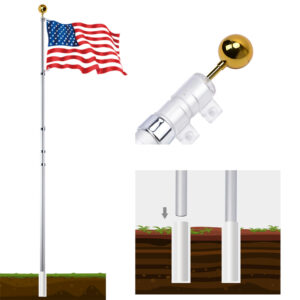
- In-ground pole — set into a concrete footing in the yard. The most stable option and the only one that reaches the taller heights comfortably. It needs digging, curing time and a clear position away from underground services.
- Wall-mounted or house-mount pole — fixed to the façade with a bracket. Ideal for a narrow frontage or a paved approach where nothing can be dug. It keeps the display close to the building and short enough to manage from a window or a step ladder.
- Roof-mounted pole — bolted through brackets on the roof structure. Suited to limited ground space, but the roof must be sound and the mounting points must land on framing rather than on a thin covering.
- Portable base or deck mount — a short pole on a weighted or bolted base. Flexible and removable, best for seasonal display and for renters who cannot drill or dig.
A well-specified wall-mount product shows what matters in this category: a sectional shaft for easy assembly and storage, a rotating round head so the flag swings freely instead of wrapping the pole, an alloy base plate to spread the load, and two hanging buckles for straightforward attachment. Finished in black, silver, white or gold, the same format works across most façade palettes, and in stainless steel it also suits coastal exposure.
Material Comparison: Aluminum, Fiberglass, Steel and Wood
| Material | Advantages | Trade-offs |
|---|---|---|
| Aluminum | Light, rust-resistant, easy to install, moderate cost | Can dent; a thin wall bends in strong wind, and it looks more modern than traditional |
| Fiberglass | Fade-resistant, corrosion-free, handles temperature extremes, mouldable profiles | Higher cost and less widely available |
| Stainless steel | Strong, clean appearance, holds up in coastal air | Highest material cost |
| Painted steel | Strength at a lower price | Needs rust checks at chips, joints and the base |
| Wood | Traditional character, easy to repair locally | Rot, splintering and insect damage without regular treatment |
The decision narrows quickly: aluminum for a short pole on a sheltered site, fiberglass or stainless where the house faces salt air or open wind, and wood only where an annual maintenance cycle is acceptable.
Height and Placement: Getting the Proportion Right
Residential poles commonly sit in the 15 to 25 foot band for a ground-mounted display, with shorter sectional units on the wall or roof where space is limited. The number that matters is not the pole height on its own but the sightline: if the house sits on rising ground, or a mature tree stands between the pole and the road, the flag will be hidden unless the pole is raised or the position moved.
Proportion matters too. A flag that is too large for its pole cannot stream properly, so it wears faster and reads as heavy; one that is too small turns the display into a detail. Settle the flag size — standard stock sizes such as 3 by 5 feet and 4 by 6 feet cover most homes — at the same time as the pole, and confirm that the poles and flag are approved together.
Practical placement rules are short: keep the pole clear of overhead power lines and branches, avoid a position where the flag will strike a wall or a gutter, and choose a spot where raising and lowering does not require special equipment. A display that is awkward to operate will not be used.
Installation Methods and Load Paths
Ground mounting remains the most common choice because it is the most stable: the pole is set into concrete, which resists both wind load and the leverage of a long shaft. It deserves the extra effort of a properly sized footing and a plumb check while the concrete cures.
Roof and wall mounting shift that load into the building, which is why substrate matters more than the bracket. Fixings must reach solid framing or masonry; a bracket screwed into cladding will hold the pole on a calm day and fail on the first storm. Where the structure cannot take the load, reduce the pole height, change mount type or consult a professional installer rather than increasing the fixing torque.
Follow the manufacturer’s assembly sequence instead of improvising, then inspect the installation after the first storm: movement at the base or bracket is the earliest warning sign.
Hardware and Accessories Worth Adding
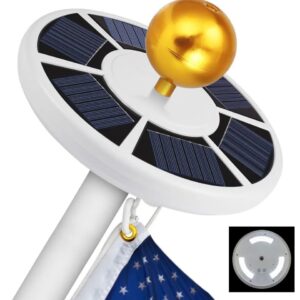
Hardware decides how long the setup looks good. Flag rings and clips size the flag to the pole diameter and hold it without pinching; hardware is commonly supplied in white and black so it blends with the shaft. A finial or ornament finishes the top of the pole, and it is worth checking the material will not corrode. A pole light keeps the flag displayed after dark, with solar units avoiding any wiring run. Buyers who order the pole, the rings and the light as one specification avoid mismatched diameters later. Compatible parts are listed under flagpole accessories.
Maintenance and Seasonal Checks
- Clean the pole at least once a year with mild soap and water; rinse well.
- Inspect the halyard and pulley system, which wear faster than the shaft.
- Check for rust at chips and joints on painted steel, and touch up the finish before corrosion spreads.
- Confirm the base or bracket is still tight, particularly after storms.
- Take the flag in before severe weather rather than replacing it afterwards.
On the flag itself, polyester holds colour and resists tearing through a full outdoor season, while cotton fades faster and needs more care. Keeping a spare flag means the pole stays in use while the other is cleaned or repaired. Full outdoor options are grouped in the outdoor flag pole range, and matching interior formats are available for indoor display.
Local Rules and HOA Approvals
Many communities regulate pole height and placement, and some go further, covering flag size, illumination and even the colours that may be used on the pole or flag. Where a homeowners association is involved, the rules may be stricter than the municipal ones and may restrict certain displays outright.
The efficient sequence is to check both sets of rules before ordering: municipality first, then association, then the supplier. Any conflict is far easier to resolve on paper than after a footing has been poured. Keep a written record of the approval in case a neighbour raises the question later.
Residential Flag Pole Options Compared
| Consideration | Typical range | Rule that applies |
|---|---|---|
| Height | 15 to 25 feet for ground-mounted; shorter for wall and roof mount | Local height limits and HOA rules may cap it |
| Material | Aluminum, fiberglass, stainless steel, painted steel, wood | Some associations specify preferred finishes and colours |
| Mounting | In-ground footing, wall bracket, roof bracket, portable base | Approval may be required for roof and wall fixings |
| Flag size | Common stock sizes of 3 by 5 feet and 4 by 6 feet | Some areas restrict flag dimensions |
| Lighting | Optional pole light, including solar units | Illumination rules vary and may affect the choice |
| Maintenance | Annual cleaning plus post-storm inspection | Association rules on appearance may set the standard |

Frequently Asked Questions
How tall should a residential pole be?
Tall enough for the flag to clear the roofline and nearby trees when seen from the street. Ground-mounted poles usually sit between 15 and 25 feet; wall and roof mounts are shorter by design.
Is a wall-mounted pole strong enough for a house?
It is, provided the bracket is fixed into solid framing or masonry and the pole height is kept sensible. The failure point in wall-mounted installations is almost always the fixing, not the shaft.
Send Your House and Site Details
Tell us the mounting surface you have, the height you want the flag to sit at, your local wind exposure and any HOA restrictions you are working within. We will match a pole format, finish and accessory set to that brief and return the specification and installation documentation your customer will need. Start with the quote request form; if you are still deciding between residential formats, the product catalogue groups them by mounting type.